
Japan's J-PARC Uses Negative Muon Non-Destructive Analysis to Reveal Gold-Rich Surface Structure of Nagoya Castle's Golden Shachi Scales
 Scan to share
A joint research team comprising the High Energy Accelerator Research Organization (KEK), the J-PARC Center, the Nagoya Castle Research Center, and the National Museum of Nature and Science, among others, used the negative muon beam at the J-PARC Materials and Life Science Experimental Facility (MLF) to conduct non-destructive depth analysis on seven surviving scales of the golden shachi on Nagoya Castle's keep, confirming that five of the scales have a layered structure with high gold content within approximately 10 micrometers of the surface.
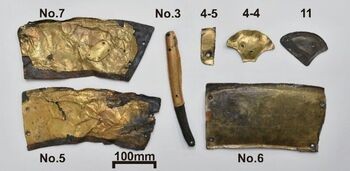
The golden shachi on Nagoya Castle's keep was largely destroyed in the air raids of 1945, with some scales rescued and preserved to this day. Previously, researchers had examined these scales using X-ray fluorescence analysis, but the results showed that some scales with a bright golden appearance did not necessarily have a high average gold content. The research team believes that the golden luster perceived by the human eye is primarily influenced by surface composition, while conventional X-ray fluorescence analysis reflects average information over a certain depth range, necessitating further understanding of the distribution of gold and silver elements from the surface to the interior.
This study employed the negative muon analysis method. Negative muons can have their stopping depth in materials adjusted by varying the beam momentum, and after being captured by atoms, they emit element-specific muonic characteristic X-rays. Using this approach, the researchers measured the distribution of gold and silver from the surface to the interior of the scales without cutting or scraping the samples.
The results showed that, except for measurement points 5 and 11, the remaining five measurement points exhibited an increasing trend in gold concentration in the near-surface region, with near-surface gold concentrations of approximately 65% to 90% (weight percent), with specific values varying depending on sample origin and condition. At one measurement point, averaging the negative muon results over a depth of approximately 13 micrometers yielded a gold concentration of 77±0.12 wt%, which is consistent with the 76±0.8 wt% obtained by X-ray fluorescence analysis, indicating that the two methods reflect information from different depths but produce consistent results.
The study also found that the gold concentration in a suspected restoration area remained largely stable at approximately 82% to 84 wt%, showing almost no variation with depth; in contrast, unrestored areas exhibited a characteristic of higher gold concentration closer to the surface. This indicates that negative muon depth analysis can not only identify surface differences but also capture variations in internal material structure and restoration traces.
The research team believes that these results suggest that the golden shachi scales may have undergone some form of surface treatment historically to enhance the near-surface gold content and intensify the golden luster. This method also demonstrates the potential of negative muon technology in cultural heritage research, enabling the analysis of manufacturing techniques and restoration histories of gold and silver artifacts, coins, jewelry, gilded objects, and polychrome historical artifacts without damaging precious cultural properties.
Disclaimer: Information republished from partner media, institutions or other websites is provided for reference and communication purposes only. It does not imply endorsement of its views or verification of its accuracy. Please contact us if any content infringes rights or requires correction.