
NMR Reveals Thermal Self-Organization in Resistive Switching of Organic Conductor by Japanese Team
 Scan to share
A joint research team from Tokyo University of Science, the National Institute for Materials Science, and RIKEN in Japan recently used bulk-sensitive ¹H-NMR measurements to reveal the internal electronic state of the organic conductor (d7-DMe-DCNQI)2Cu during resistive switching. The study found that, in the switching state, the material does not form a uniform new electronic phase, but rather a coexistence of metallic and insulating phases within the material.
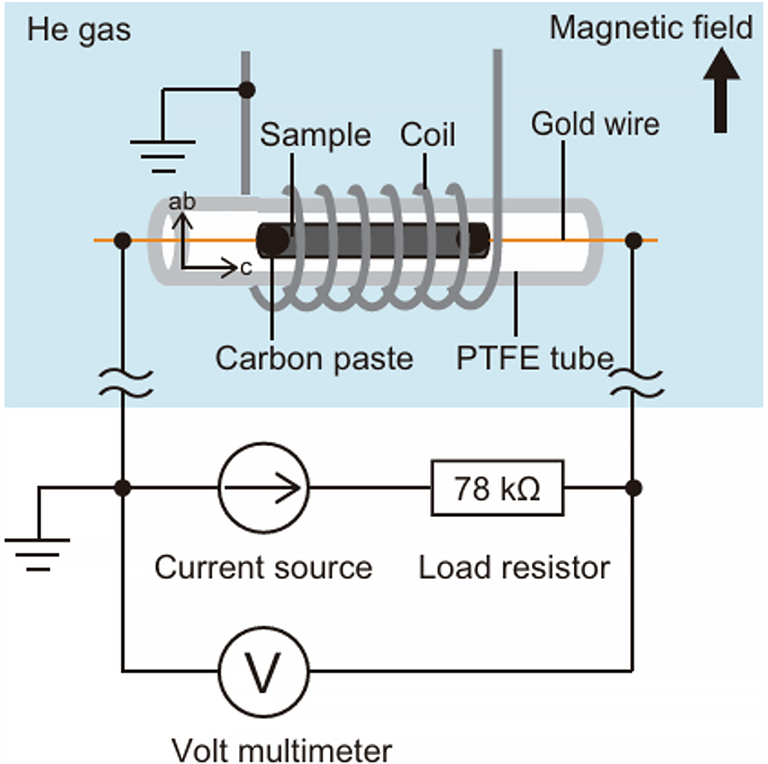
Schematic of bulk-crystal ¹H-NMR measurements
Resistive switching refers to the phenomenon in which a material's resistance changes significantly under an applied current or voltage, and has attracted attention in research on correlated electron systems, memory devices, and neuromorphic devices. Previous studies have mostly focused on inorganic thin-film materials, but factors such as substrate heat dissipation and broad phase-transition temperature ranges have made it difficult to clearly distinguish the relationship between Joule heating and phase transitions. In this study, a bulk organic conductor was selected as the object of study, which exhibits a very sharp metal—insulator transition at approximately 79 K and has weak thermal coupling with the surrounding environment, facilitating observation of the connection between current-induced heating and phase transitions.
By combining electrical transport measurements and ¹H-NMR measurements, the research team found that under low-current conditions, the sample exhibits a sharp resistance transition from the metallic phase to the insulating phase near approximately 79 K; however, when a larger current is applied and the sample is cooled, the material enters a resistive switching state with an intermediate resistance value. This state can be maintained even as the ambient temperature continues to decrease, indicating that the sample enters a non-equilibrium steady state in which Joule heat generation and outward heat dissipation are balanced.
The ¹H-NMR relaxation results showed that the relaxation curves of both the normal metallic phase and the insulating phase could be described by a single exponential function, whereas in the resistive switching state, two relaxation components appeared, corresponding to the metallic and insulating phases, respectively. This result directly demonstrates the coexistence of phases in the switching state.
The study also confirmed a "temperature-pinning effect": even when the ambient temperature is below the metal—insulator transition temperature, most regions of the sample remain at approximately 79 K. Meanwhile, within a certain current range, the material exhibits a relationship in which voltage is approximately inversely proportional to current, i.e., V∝1/I. Since this is opposite to the proportional relationship between voltage and current in Ohm's law, the research team termed it the "inverse Ohm's law."
The study suggests that these seemingly anomalous phenomena originate from "thermal self-organization": the ratio of metallic to insulating phases autonomously adjusts according to the balance between Joule heat generation and environmental heat dissipation, thereby maintaining the stability of the internal temperature and conductive pathways in the material. The research team stated that these results indicate resistive switching should not be understood merely as a response to uniform heating of the material, but rather as a non-equilibrium steady state formed by the coupling of phase transitions, heat flow, and electrical conduction.
The related results were published online in Physical Review Applied on August 17, 2026, and were selected as an Editors' Suggestion.
Disclaimer: Information republished from partner media, institutions or other websites is provided for reference and communication purposes only. It does not imply endorsement of its views or verification of its accuracy. Please contact us if any content infringes rights or requires correction.