
Thailand Advances SMR Regulatory and Public Engagement Preparations, Plans to Commission First Unit by 2037
 Scan to share
From September 9 to 11, 2026, the U.S. Department of State held the “FIRST and Thailand Stakeholder Engagement Workshop” in Bangkok. The workshop was co-hosted by the Thailand Institute of Nuclear Technology (TINT) and the Electricity Generating Authority of Thailand (EGAT), aiming to support Thailand's preliminary preparations for small modular reactors (SMRs), with a focus on transparent communication, public trust, and stakeholder engagement.
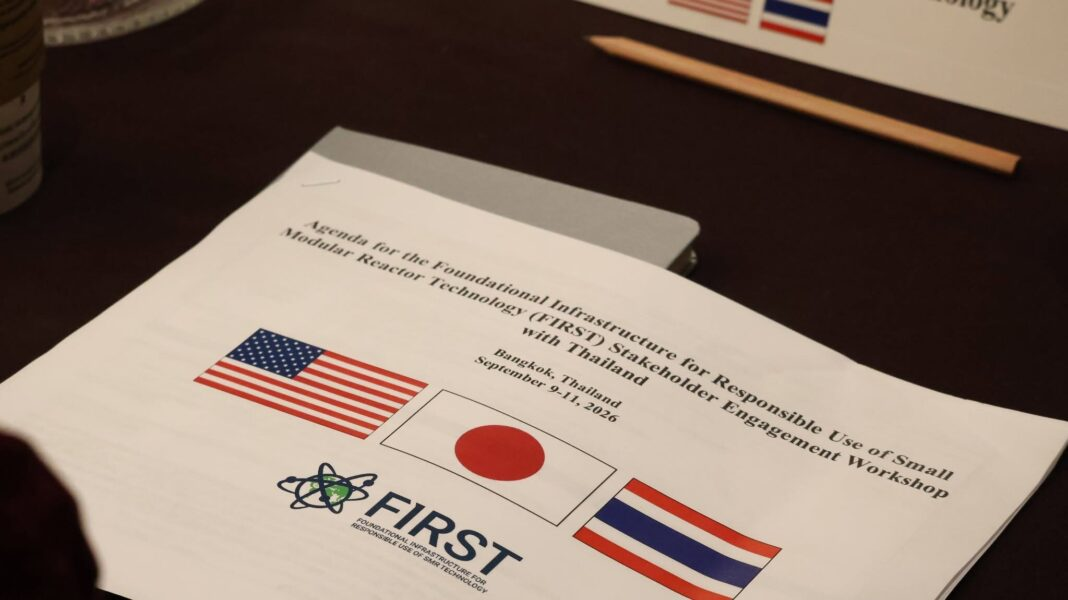
The FIRST program, whose full name is “Foundational Infrastructure for the Responsible Use of Small Modular Reactor Technology,” was initiated by the U.S. Department of State and mainly supports relevant countries in improving infrastructure and capacity building before the safe, reliable, and responsible adoption of SMR technology. During the workshop, representatives from Thailand's energy authorities, energy agencies, research institutes, and universities exchanged experience on topics including stakeholder analysis, risk communication, public trust building, information dissemination channels, countering disinformation, and youth and community engagement, and discussed how to establish an engagement framework suited to Thailand's national conditions through public opinion surveys.
The Thai side emphasized that nuclear energy development depends not only on technological maturity but also on regulatory capacity, information transparency, and the degree of public and community engagement. Relevant agencies believe that future discussions on introducing SMR technology should be based on reliable data and fully consider the views of the public and stakeholders.
Meanwhile, Thailand is advancing the development of SMR regulatory, industrial, and talent systems. Thailand's Committee on the Peaceful Uses of Nuclear Energy has approved a policy framework requiring relevant standards to align with International Atomic Energy Agency (IAEA) requirements. According to the IAEA's nuclear energy infrastructure assessment methodology, Thailand has a certain foundation of readiness in 10 of 19 requirements, 6 areas still require further development, and 3 areas need priority advancement, namely formulating national policy, establishing a nuclear energy program implementing organization, and developing a financing plan.
Regarding follow-up preparations, relevant Thai agencies have identified several key tasks. The Office of Atoms for Peace will accelerate the drafting of legislation related to civil liability for nuclear damage to establish insurance, financial guarantee, and national fund mechanisms in line with international standards; the Ministry of Higher Education, Science, Research and Innovation and other departments will promote education and training and long-term talent cultivation in SMR technology and nuclear safety regulation; Thailand will also formulate a national policy on radioactive waste management and study ways to promote domestic industry chain participation in the global SMR supply chain.
According to Thailand's draft 2026 power development plan, Thailand plans to connect its first 300-megawatt SMR unit to the national grid by 2037. The plan includes SMRs as part of the power system roadmap from 2026 to 2050, to address the growth in clean electricity demand brought by industries such as artificial intelligence, data centers, and electric vehicles. Under the current plan, Thailand's total SMR installed capacity could reach 9,000 megawatts by 2050.
The Electricity Generating Authority of Thailand has been designated to lead the first proposed 300-megawatt SMR project, responsible for preliminary work including feasibility studies, site selection, and reactor technology selection. Currently, Thailand has not yet determined the nuclear power plant site, nor announced a specific technology route or supplier.
In terms of international cooperation, the U.S.-Thailand civil nuclear cooperation agreement entered into force in July 2025. Thailand is also maintaining contact with other nuclear energy technology suppliers. In 2024, the Electricity Generating Authority of Thailand signed an SMR cooperation agreement with an overseas platform related to China National Nuclear Corporation, covering SMR technology and its potential application in Thailand; in 2025, the Electricity Generating Authority of Thailand also signed a cooperation agreement with Korea Hydro & Nuclear Power. Thailand's Office of Atoms for Peace has also held consultations with China's National Nuclear Safety Administration on topics including nuclear regulation, licensing, verification, and talent cultivation.
Disclaimer: Information republished from partner media, institutions or other websites is provided for reference and communication purposes only. It does not imply endorsement of its views or verification of its accuracy. Please contact us if any content infringes rights or requires correction.