
Signed Article by Liu Mingsheng, Chairman and Party Secretary of State Power Investment Corporation (SPIC)
 Scan to share
Liu Mingsheng, Chairman and Party Secretary of State Power Investment Corporation (SPIC)
At present, a new round of technological revolution is converging historically with the green, low-carbon transformation of energy, and future industries are becoming a strategic battleground for reshaping the global competitive landscape. General Secretary Xi Jinping's series of important remarks on future industries, made from the strategic height of advancing the building of a strong nation and the great cause of national rejuvenation, provide important guidance for developing future industries, building a modern industrial system, and grasping the initiative in development. As the world's largest clean energy power generation enterprise, SPIC has always regarded the development of future industries as a strategic lever for safeguarding the nation's long-term energy security and winning the initiative in development. Closely aligning with national strategic needs, we actively leverage our comparative advantages, strive to achieve new breakthroughs in the development of future industries, and accelerate the cultivation of new quality productive forces.
I. Deeply Understanding the Significant Importance of Developing Future Industries
Future industries are forward-looking emerging industries driven by breakthrough and disruptive frontier major scientific and technological innovations, which play a leading and supporting role in future economic and social development. They are characterized by their pioneering nature, strategic significance, long-term orientation, and uncertainty. SPIC conscientiously implements the strategic deployment made at the Fourth Plenary Session of the 20th Central Committee of the Communist Party of China to cultivate and expand future industries, treating the development of industries such as hydrogen energy, fusion energy, and embodied intelligence as mandatory tasks leading future development, and enhancing our historical sense of mission and practical urgency to secure an early position and build deep capabilities.
This is an inevitable choice for addressing the dual challenges of energy security and low-carbon transformation. China's energy resource endowment determines that relying solely on traditional technological iteration cannot fundamentally resolve the contradiction between supply security and emission reduction. Green hydrogen-based energy can achieve large-scale and deep substitution for fossil fuels. Once nuclear fusion technology achieves commercialization, it will provide nearly limitless clean baseload energy. Energy and power robots are intelligent carriers that enhance safety in complex environments and achieve the goal of "fewer personnel for safety, zero personnel for security." Hydrogen ion implantation technology empowers the upgrading of power semiconductors, improving energy conversion efficiency and consolidating the foundation for the self-reliance and controllability of the energy industry.
This is a realistic path to forge new quality productive forces by leveraging core business advantages. Developing future industries does not mean "starting from scratch," but rather using existing advantages to leap toward higher technological dimensions and deeper value chain segments, achieving a strategic upgrade from a clean energy power generation leader to a leading enterprise in future energy technology. SPIC possesses 200 million kilowatts of clean energy installed capacity, abundant industrial carbon emission scenarios, and complete power engineering capabilities. This industrial depth provides a natural and enormous testing ground and source of demand for green hydrogen production, fusion engineering validation, special robot iteration, and power semiconductor applications, facilitating the accelerated transformation into new quality productive forces.
II. Achieving New Breakthroughs in the Future Energy Industry Track by Leveraging Comparative Advantages
The key to developing future industries lies in transforming strategic visions into concrete projects and tangible results. SPIC is anchored on the goal of building itself into a leading technology enterprise, grounded in objective conditions, adhering to the principle of "industry poses the questions, technology provides the answers," and has taken solid steps in key areas.
In the field of green hydrogen-based energy, we are focusing on connecting the entire industrial chain and exploring sustainable business models. SPIC has established a specialized platform, "SPIC Green Energy," to tackle the integrated challenge of "green power-green hydrogen-green ammonia." Its landmark project—the Da'an Wind-Solar-Green Hydrogen-Green Ammonia Integrated Demonstration Project in Jilin Province—was fully completed and put into operation in 2025, obtaining the world's first green ammonia certification and setting four global records: the world's largest single-phase green ammonia project (180,000 tonnes annual production); the world's largest alkaline and PEM hybrid water electrolysis hydrogen production system; the world's largest new energy DC microgrid hydrogen production system; and the world's largest solid-state hydrogen storage facility. Notably, the project successfully deployed an independently developed intellectual property "power-hydrogen-ammonia" full-process flexible control system, solving the challenge of matching the volatility of wind and solar power generation with the stability requirements of chemical production, becoming the core technology supporting the entire industrial chain. To date, the project has cumulatively produced over 30,000 tonnes of green ammonia, strongly demonstrating the feasibility and economic potential of large-scale green hydrogen projects. SPIC will replicate and promote the Da'an experience in more regions rich in wind and solar resources, accelerating the scale of the green hydrogen-based energy industry to new heights.

▲Jilin Da'an Wind-Solar-Green Hydrogen-Green Ammonia Integrated Demonstration Project
In the field of nuclear fusion energy, we focus on long-term strategic reserves, emphasizing the accumulation of engineering implementation and system integration capabilities. Fusion energy is the "crown jewel" of future baseload energy, and countries around the world are increasing investment and engaging in fierce competition. SPIC actively integrates into the national fusion strategy system, closely collaborates with advantageous institutions such as the Chinese Academy of Sciences, and deeply participates in the design of heat transfer loop schemes and the development of key equipment for the national fusion reactor engineering. We have now assembled a core team dedicated to fusion reactor engineering, and jointly established the "Digital Fusion Reactor" Beijing Key Laboratory, focusing on solving key engineering challenges such as full lifecycle digital simulation and maintenance of fusion devices. Going forward, we will leverage our advantages in engineering organization and system integration to reserve valuable engineering data, process know-how, and professional talent for the nation's construction of fusion power plants, building a solid bridge from physical experiments to grid-connected power generation.
In the field of energy and power robots, we adhere to a demand-oriented approach, empowering intrinsic safety and quality and efficiency improvement through intelligent robots. Embodied intelligence is an important future industry direction clearly defined in the "15th Five-Year Plan," and intelligent robots are one of the primary application carriers and product forms of embodied intelligence. The complex and high-risk scenarios of the energy and power sector are precisely the "training ground" for their application. SPIC has established a specialized robotics company, systematically identified application needs from frontline scenarios in nuclear power, thermal power, new energy, and aluminum industries, and successfully developed more than 40 types of special robots, including reactor pressure vessel inspection robots and photovoltaic module cleaning robots, with cumulative sales exceeding 600 units (sets). In 2026, the company was approved by the State-owned Assets Supervision and Administration Commission of the State Council as a "Qihang" (Pioneering) enterprise. SPIC has now formed a professional robotics R&D team and will provide stable research funding during the "15th Five-Year Plan" period to accelerate the building of a national team for energy and power robotics.
In the field of ion implantation technology, we pursue a dual-track approach of process and equipment development to create Chinese "core" power for semiconductors. Hydrogen ion implantation technology is a core and critical process in the manufacturing of power semiconductor devices, holding significant strategic importance for industrial development. Since SPIC began its deployment in 2021, it has completed a full-chain breakthrough in hydrogen ion implantation for power semiconductors within four years, delivering nearly 10,000 wafers to leading domestic semiconductor companies, providing core support for the independent upgrading of the power semiconductor industry and offering strong industrial chain security guarantees for strategic industries such as new energy, ultra-high voltage transmission, and rail transit.
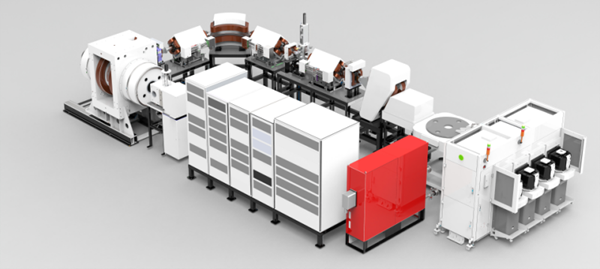
▲SPIC-2000H High-Energy Hydrogen Ion Implanter
III. Identifying the Obstacles Facing the Development of Future Industries
The development of future industries involves a wide range of areas, and factors such as technological and market uncertainty, as well as the inadaptability of traditional management mechanisms, pose practical challenges to the high-quality development of future industries.
The long cycle of technological breakthroughs coexists with the urgency of commercial validation. The green premium for green hydrogen-based energy products has not yet been fully realized, and continued cost reduction and efficiency improvement through large-scale production and technological innovation are still needed. Nuclear fusion energy is still in the engineering experimentation stage, requiring sustained efforts before commercial power generation. The reliability and intelligence level of special robots under extreme conditions such as strong radiation and ultra-high temperatures still need improvement. Hydrogen ion implantation equipment demands high precision, and technical breakthroughs are still needed in areas such as beam stability and precise control of target temperature fields. This places high demands on the pacing of resource allocation—requiring both strategic patience during the cultivation process and the demonstration of technological value through phased results.
The mechanisms for bridging the gap from "laboratory to production line" still need improvement. Future technology validation costs are high, and the risks of first-application are significant. Although scenario cultivation and opening are being accelerated, there are still shortcomings in the pilot testing stage, and bottlenecks or gaps remain in the entry of first-of-a-kind (FOAK) equipment into production, requiring more precise policy support and mechanism safeguards.
The synergy of the innovation ecosystem needs optimization. Future industries have long cultivation cycles, high investment requirements, and low early-stage output, and involve multiple stages including basic research, engineering transformation, and industrial application, which are distributed among different entities such as universities, research institutions, and enterprises. It is necessary to fully leverage the advantages of the new nationwide system for mobilizing resources, build a collaborative ecosystem that connects all innovation entities, and pool efforts to tackle key challenges.
IV. Ensuring and Promoting the High-Quality Development of Future Industries Through Further Deepening of Reform
SPIC will adhere to the combination of goal orientation and problem orientation, using reform measures to solve the challenges encountered in practical exploration, ensuring that future industries take root and flourish at an accelerated pace, and striving to open a "second growth curve."
Strengthening the rigid constraints and dynamic adjustment of strategic planning. SPIC has incorporated the development of future industries into the Group's Science and Technology Innovation "15th Five-Year Plan," specifying annual "hard tasks" in detail. A phased "value assessment" mechanism has been established to avoid both interrupting long-term R&D due to short-term commercialization pressure and relaxing the output requirements for phased research results due to long-cycle expectations, ensuring that long-term and short-term resource allocation is properly resolved and paced in a controllable manner.
Substantively implementing scenario opening and pilot-scale maturation systems. SPIC will establish a "scenario opening list" and special validation funding for future industries, designating scenarios in nuclear power, new energy, and aluminum industries as the "responsibility fields" for first trials and first applications of future industry technologies, and relieving frontline production units of assessment concerns arising from trying new technologies. At the same time, we will jointly establish innovation consortia with upstream and downstream partners, increase safeguards for talent and funding, implement mission-oriented research in "bottleneck" areas, and concentrate efforts to shorten the technology maturation cycle.
Building new mechanisms for integrated research and application by leveraging the new nationwide system for mobilizing resources. SPIC will proactively integrate into the national strategic layout for future industries, fully leverage the advantages of the new nationwide system, promote the establishment of a collaborative research model driven by national missions and guided by industrial demand, explore the construction of new mechanisms for integrated research and application, break down barriers between basic research, engineering transformation, and industrial application, and promote a shift of all innovation entities from "segmented responsibility" to "full-process collaboration."
Looking ahead to the "15th Five-Year Plan" period, future industries will grow into key engines supporting the sustained development of the national economy and driving the optimization and upgrading of the industrial structure. SPIC will focus on what the nation needs and what we excel at, gain forward-looking insights into the transformation of the energy industry, dedicate ourselves to tackling key core technologies, and strive to be the main force and vanguard on the new track of future industries, making new and greater contributions to forging the nation's strategic scientific and technological strength in energy and advancing Chinese modernization.
Disclaimer: Information republished from partner media, institutions or other websites is provided for reference and communication purposes only. It does not imply endorsement of its views or verification of its accuracy. Please contact us if any content infringes rights or requires correction.