
Startorus Fusion Completes 20 K Cryogenic Rapid Discharge Test of Central Solenoid Model Magnet (CSMC) for Spherical Tokamak Device
 Scan to share
Startorus Fusion (HTS) recently announced that its independently developed central solenoid (CS) model magnet for a spherical tokamak device (tokamak) successfully completed a 6350 A cryogenic current-carrying and rapid discharge test under harsh cryogenic conditions. Test results showed that the magnet achieved a maximum magnetic field of 10 T and a magnetic field change rate of up to 63 T/s, setting a new record for the magnetic field change rate of known fusion superconducting magnets.
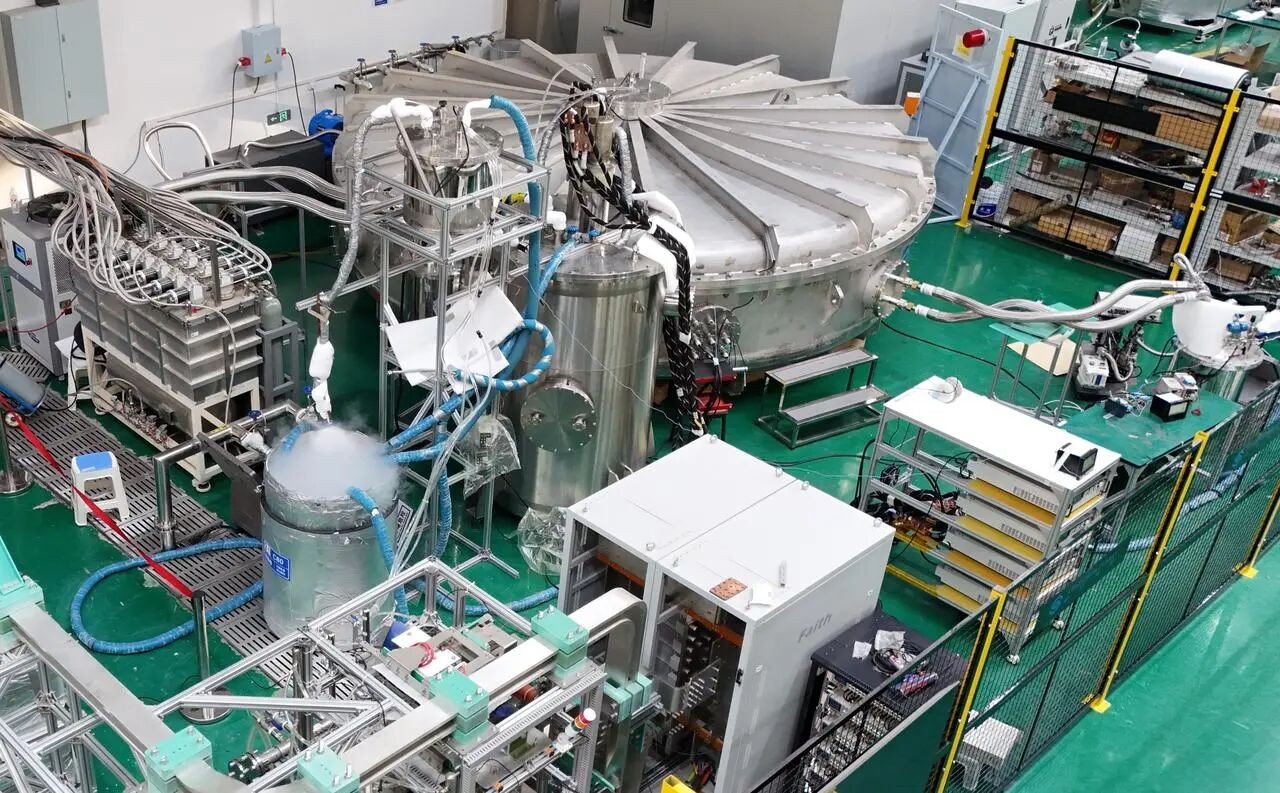
This test was conducted at 20 K (-253 °C). The magnet not only successfully reached a maximum magnetic field strength of 10 T, with a central magnetic field of 7.6 T, but also smoothly completed the rapid discharge test required for tokamak ohmic discharge. As an engineering validation prototype for the CS magnet development of the CTRFR-1 (Startorus-1) device, this test comprehensively validated the key stages from design, manufacturing, and assembly to cryogenic operation and discharge testing.
High engineering current density and rapid discharge capability are prominent features of this central solenoid magnet. The magnet has an inner diameter of 350 mm, an outer diameter of 520 mm, a height of 270 mm, and an inductance of 71 mH. Its tape current density is approximately 290 A/mm², and considering structures such as the frame, joints, and cooling plates, the engineering current density reaches 120 A/mm², fully demonstrating Startorus Fusion's leading technical strength in the field of compact, high current density, fast magnetic field change rate central solenoid magnets.
During the cryogenic test, the magnet achieved a stable current-carrying capacity of 6350 A and completed the rapid discharge test, with a maximum current change rate of 40 kA/s, a maximum voltage of up to 2850 V, corresponding to a device loop voltage of 6.75 V. Test results confirmed that the magnet can fully withstand the electromagnetic forces and thermal loads during high-current excitation and rapid discharge. More importantly, after dozens of current-carrying, demagnetization, and rapid discharge tests, the magnet's main performance and key test signals remained normal, validating the feasibility of its high current density electromagnetic design, coil fabrication and overall assembly process, cryogenic cooling scheme, and rapid discharge operation path.
To simultaneously validate magnet performance, Startorus Fusion also conducted fiber optic monitoring of key physical quantities of the magnet and core structures. Using an independently developed fiber optic demodulator, fiber optic signals at the same measurement points were compared with signals from conventional strain gauges and temperature sensors. Preliminary results showed that fiber optic monitoring and conventional measurement methods were highly consistent in signal changes, providing a new technical path and means for health monitoring of large magnets. Fiber optic monitoring is expected to achieve multi-point state sensing and local anomaly identification inside and on the surface of magnets, safeguarding the safe and reliable operation of future large magnets.
This test fully demonstrated Startorus Fusion's full-chain system integration capability, covering all aspects from superconducting tape processing and coil manufacturing to cryogenic test system integration. The company continued to use its existing independently developed equipment and technical systems, and completed the development and integration of tape encapsulation and magnet impregnation processes, key components (such as cooling pipe insulation terminals, magnet transposition joints, and current leads), and circuit breaker systems to meet the requirements of encapsulated tape, compact structures, and rapid discharge testing. The independently designed circuit breaker system can achieve a maximum voltage of 5 kV, a maximum current of 9 kA, and a turn-off time of less than 10 μs, successfully completing rapid discharge control of the magnet under 6350 A operating conditions.
In addition, Startorus Fusion also used its independently developed Extreme Physics Integrated Comprehensive tester (EPIC) for signal acquisition, and independently designed and assembled the cryogenic and vacuum systems and control systems, achieving unified monitoring and control of magnet excitation, demagnetization, rapid discharge, refrigeration system, and protection status.
In the future, Startorus Fusion plans to conduct excitation and discharge tests of the central solenoid model magnet at above 12 T, and multiple repeated discharge tests at above 10 T, while accurately measuring and evaluating AC losses. Subsequent magnet research and development work is also steadily advancing, including the development of PFMC magnets, the upcoming launch of independently developed high-temperature superconducting current leads and independently developed superconducting pulse power supplies, and the completion of CTRFR-1 physics and engineering design. It is expected that in 2027, Startorus Fusion will commence batch manufacturing of magnets for the CTRFR-1 device in Shanghai.
Disclaimer: Information republished from partner media, institutions or other websites is provided for reference and communication purposes only. It does not imply endorsement of its views or verification of its accuracy. Please contact us if any content infringes rights or requires correction.