
Search Results
Keyword:)

HD Hyundai Chairman to Meet Bill Gates to Advance SMR Cooperation
HD Hyundai Chairman Chung Ki-sun will meet Bill Gates, who is visiting South Korea, on August 14, with the two sides planning discussions on cooperation in small modular reactors (SMRs). Gates, co-founder of Microsoft, also serves as chairman of TerraPower, a U.S. small modular reactor company. This will be the latest round of communication between Chung and Gates on related cooperation, following their meeting earlier this year at the Davos Forum in Switzerland. HD Hyundai and TerraPower have been steadily strengthening cooperation in SMR and advanced reactor manufacturing in recent years. In November 2022, HD Korea Shipbuilding & Marine Engineering invested $30 million in TerraPower. In December 2024, HD Hyundai secured an order to manufacture the reactor vessel for TerraPower's 345 MW sodium-cooled fast reactor (SFR) to be built in Wyoming, U.S.
2026-08-13

South Korea's Two Ministries Sign MOU to Promote Regulatory Cooperation for Nuclear Power Exports
South Korea's Ministry of Trade, Industry and Energy (MOTIE) and the Nuclear Safety and Security Commission (NSSC) signed a memorandum of understanding on the successful overseas expansion of Korean-style nuclear power plants at the Korea Trade Insurance Corporation in Jongno-gu, Seoul on August 13, planning to strengthen regulatory coordination in the nuclear power export process and provide more systematic nuclear safety regulatory cooperation support to countries hosting potential projects. Under the agreement, the two sides will jointly support export target countries in establishing nuclear safety regulatory frameworks, improving licensing procedures and technical standards, and enhancing the professional capabilities of regulatory bodies, based on the regulatory cooperation needs raised by these countries. The South Korean government is promoting nuclear power plant exports with a focus on potential markets in Southeast Asia such as Vietnam, and the relevant countries are in the process of planning and...
2026-08-13

Texas to Accelerate Opening of Sterile Fly Facility to Combat New World Screwworm Outbreak
The U.S. Department of Agriculture announced that, in response to the New World screwworm (NWS) outbreak already detected in Texas and New Mexico, the sterile fly facility at Moore Air Base in Edinburg, Texas, will open early next spring, approximately seven months ahead of the original schedule. Construction on the facility began in April of this year, and once completed, it will produce sterile flies to support outbreak control efforts using the Sterile Insect Technique (SIT). Under the plan, the facility will reach full operational capacity by the end of 2028, producing approximately 300 million sterile flies per week. The Sterile Insect Technique works by releasing sterilized flies into the environment to mate with wild screwworms, thereby interrupting the reproductive cycle and reducing the risk of continued parasite spread...
2026-08-12

India's Bihar signs memorandum of understanding for $2.3 billion small modular reactor project
The government of Bihar, India recently signed investment memorandums of understanding totaling approximately $6 billion (about €5.2 billion) with several industrial enterprises, covering sectors such as steel, textiles, food processing, pharmaceuticals, and nuclear energy. Among these, the nuclear energy project investment amounts to approximately $2.3 billion, making it the largest investment proposal among the signed agreements. According to a statement issued by the office of Bihar Chief Minister Samrat Choudhary, Global Renewable Advanced Clean Energy, a recently registered company headquartered in Hyderabad in central India, signed the nuclear energy memorandum of understanding. Further details...
2026-08-12

South Korea Designates Small Modular Reactors and Nuclear Fusion as Key Future Growth Technologies
South Korean President Lee Jae-myung will chair a briefing session on the "Seven Seeds for Future Growth Engines" at the presidential office Cheong Wa Dae on the afternoon of August 12, focusing on the development pathways for advanced technologies including Small Modular Reactors (SMRs) and nuclear fusion, as well as related industrial ecosystems and supply chain security measures. According to Cheong Wa Dae, the meeting aims to jointly study advanced technology deployment with the science and industry communities, support artificial intelligence (AI) transformation, and strengthen South Korea's future industrial foundation capabilities. The seven areas designated as priorities include Small Modular Reactors, nuclear fusion, renewable energy, quantum technology, aerospace, advanced biotechnology, and advanced materials and component supply chains....
2026-08-12

South Korea and Sweden Discuss Cooperation on High-Level Waste Disposal and SMR Regulation
The Nuclear Safety and Security Commission (NSSC) of South Korea announced on August 10 that it held a bilateral meeting with the Swedish Radiation Safety Authority (SSM) in Seoul, during which the two sides exchanged views on topics including high-level radioactive waste management, nuclear safety regulation, and the development of small modular reactors (SMRs). Sweden has accumulated strong technical expertise in the field of radioactive waste management and has developed a relatively mature technical system for high-level radioactive waste disposal. Currently, Sweden has 6 operating nuclear power units and 7 permanently shut down units, 6 of which are in the decommissioning phase. Following Finland, Sweden is constructing the world's second deep geological disposal facility for high-level radioactive waste. The NSSC of South Korea...
2026-08-10

Japanese research team uses PET imaging to find tau protein pathology may be involved in onset of hallucinations and delusions in middle-aged and elderly
A research team comprising the National Institutes for Quantum Science and Technology (QST), Keio University, Kyoto University, Tokyo University of Science, and other institutions recently announced that researchers used PET imaging to observe tau protein pathology in the living brains of middle-aged and elderly psychiatric patients, and believe that such pathology may be related to psychiatric symptoms such as hallucinations and delusions that first appear after age 40. Proportion of positive tau PET and amyloid PET results Middle-aged and elderly psychosis generally refers to diseases in which psychiatric symptoms such as hallucinations and delusions first appear after age 40. Previous epidemiological studies and postmortem brain tissue studies have suggested that such symptoms may be related to neurodegenerative changes associated with dementia, but due to limited techniques for precise visualization and quantification of abnormal proteins in living brains, relevant evidence has long been insufficient.
2026-08-10

South Korea Advances K-Moonshot Initiative, Nuclear Fusion and SMR Spacecraft Listed as Key Missions
The South Korean government is accelerating the K-Moonshot initiative, seeking to tackle critical technologies that are difficult to break through via traditional research pathways through a national-level R&D organizational approach. Among these, nuclear fusion and small modular reactor (SMR) spacecraft have been included in 12 key missions, alongside new drug development, quantum technology, and artificial intelligence, all under the government's coordinated promotion. On August 10, Vice Minister Goo Hyuk-chae of the Ministry of Science and ICT (MSIT) met with the heads of the 12 mission projects and representatives of related institutions at the K-Moonshot Project Support Office in Sejong City to discuss next-stage implementation arrangements. The meeting focused on detailing...
2026-08-10
Small Modular Reactors Expected to Contribute One-Quarter of Global New Nuclear Capacity by 2050
According to data compiled by the World Nuclear Association (WNA), global nuclear power installed capacity is expected to reach 1,446 GWe by 2050. This projection is based on the continued operation of existing reactors and the implementation of announced nuclear power development targets by governments. Currently, global installed nuclear capacity stands at approximately 403 GWe. To achieve the above scale, an additional approximately 1,043 GWe of nuclear capacity will need to be added. Among this, Small Modular Reactors (SMRs) are expected to contribute about 260 GWe, accounting for roughly one-quarter of global new nuclear capacity. Factors driving nuclear power expansion are increasing. The rapid adoption of artificial intelligence applications has driven up electricity demand from data centers, and the accelerating electrification of transportation and industrial sectors has further elevated the importance of stable, low-carbon electricity supply. Meanwhile, energy security and net-zero emission targets are prompting more countries to reassess the role of nuclear energy in their energy mix.
2026-08-10

First Concrete Pour (FCD) Successfully Completed for the Conventional Island of Unit 2 at Guangxi Bailong Nuclear Power Plant
At 10:06 on August 9, after 38 hours and 46 minutes of continuous effort, the First Concrete Pour (FCD) for the conventional island of Unit 2 at the SPIC Guangxi Bailong Nuclear Power Plant was successfully completed, marking the full commencement of the main construction phase for the conventional island. The basement floor slab of the conventional island of Unit 2 adopts an integral raft foundation, divided into 9 construction zones using the sequence method. This concrete pour covered Zone 1, starting at 19:20 on August 7, with a cumulative pour of 1,732 cubic meters of concrete, conducted safely and orderly throughout the process. Since July, Typhoon Maysak directly struck Fangchenggang, bringing successive storms, followed by days of high temperatures at the Bailong nuclear site, posing significant challenges to on-site construction. In response...
2026-08-10

DXA Screening Among U.S. Medicare Population Declines 35% Over Nearly Two Decades
A new study shows that between 2005 and 2023, the rate of dual-energy X-ray absorptiometry (DXA) examinations among U.S. Medicare beneficiaries declined significantly, by 35%. DXA is commonly used for bone density testing and osteoporosis-related screening, and the findings suggest that disparities in screening access across different populations are widening. Researchers analyzed claims data from more than 5 million Medicare beneficiaries. The results showed that DXA utilization fell from 7,255 exams per 100,000 beneficiaries in 2005 to 4,690 per 100,000 beneficiaries in 2023. The study was published in Osteoporosis International. The decline was not uniform across populations...
2026-08-08

U.S. NRC to Debut Modernized Hearing Process in Advanced Reactor Licensing Review for the First Time
The U.S. Nuclear Regulatory Commission (NRC) will hold a public hearing on August 13 in Oak Ridge, Tennessee, to consider the Tennessee Valley Authority's (TVA) application to build a small modular reactor at the Clinch River site. This will mark the first time the NRC applies its modernized mandatory hearing framework in an advanced reactor licensing review. According to the NRC, the new hearing process is designed to give the public earlier insight into the agency's review of the project's safety and environmental impacts, while improving the transparency, predictability, and efficiency of licensing reviews. As part of its licensing modernization efforts, the NRC currently aims to complete construction permit-related decisions within 18 months. TVA plans to...
2026-08-07
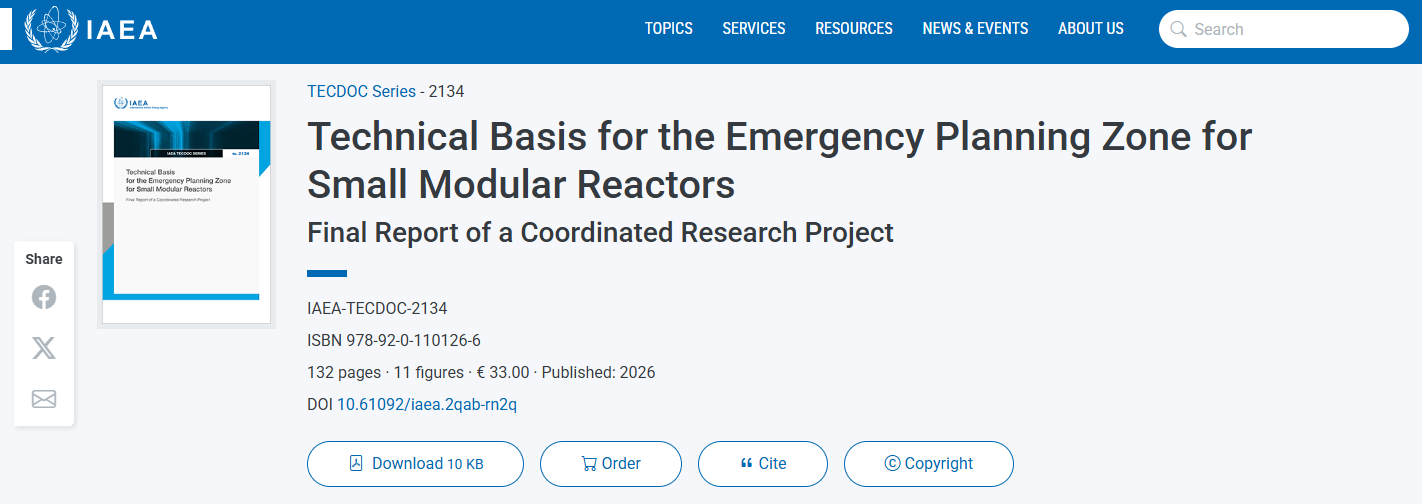
IAEA Publishes Technical Document on Emergency Planning Zones for Small Modular Reactors
The International Atomic Energy Agency (IAEA) has published TECDOC Series No. 2134, "Technical Basis for the Emergency Planning Zone for Small Modular Reactors." The document was published in Vienna in 2026, comprising 132 pages with 11 illustrations, in English. This document marks the first time the IAEA has published the results of a Coordinated Research Project (CRP) on the technical basis for emergency planning zones for Small Modular Reactor (SMR) deployment. The research project was conducted from 2018 to 2021, focusing on how to determine the technical basis for off-site emergency preparedness and response (EPR) arrangements in SMR deployment scenarios, particularly the requirements and scope for establishing emergency planning zones (EPZ).
2026-08-07
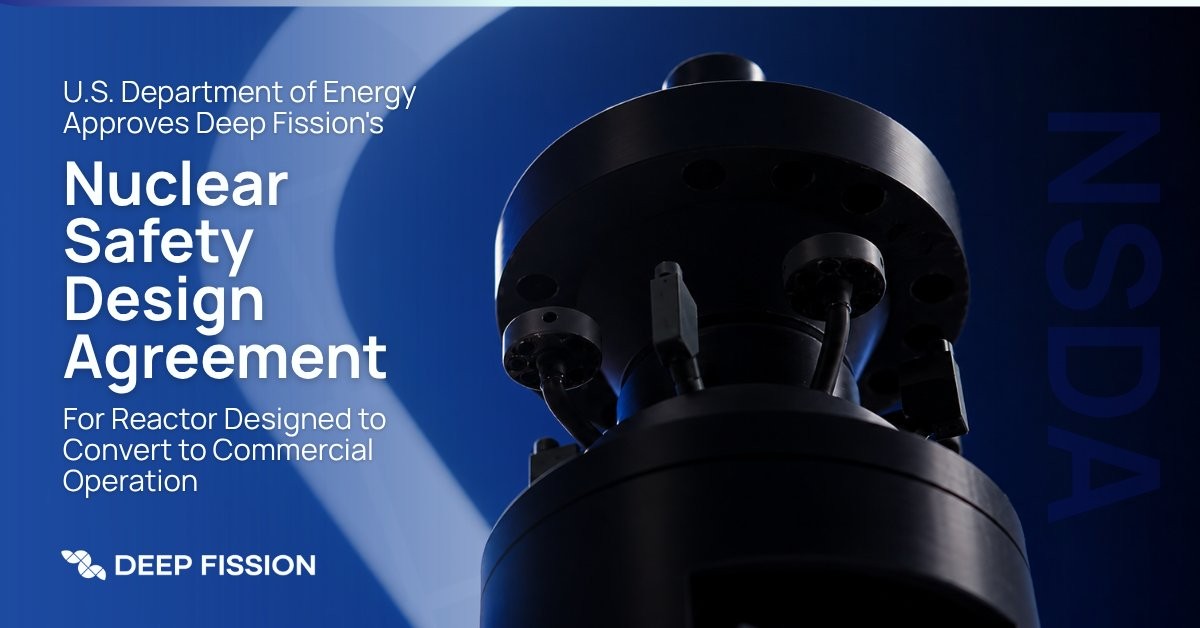
US DOE Approves Nuclear Safety Design Agreement for Deep Fission Underground SMR
Deep Fission, a US advanced nuclear energy company, announced on August 6 that the US Department of Energy (DOE) has approved the Nuclear Safety Design Agreement (NSDA) for its Gravity reactor. The company stated that this milestone means its reactor design meets the requirements for continued advancement under the DOE's Reactor Pilot Program. Deep Fission is developing a small modular pressurized water reactor concept, with plans to place the reactor in a borehole approximately 1 mile, or about 1.6 kilometers, underground. The approved Nuclear Safety Design Agreement will serve as the safety framework for subsequent reactor development work. According to the company's plans, the project will proceed into the DOE authorization process...
2026-08-07

"China Nuclear Power Development Report (2026)": China's Total Scale of Operating and Approved-Under-Construction Nuclear Power Units Ranks First in the World
On August 6, the National Energy Administration released the "China Nuclear Power Development Report (2026)". As of the end of 2025, China had a total of 112 nuclear power units in operation and approved for construction, with a total installed capacity of 125 million kilowatts, ranking first in the world. Among them, 59 units were in operation with an installed capacity of 62.48 million kilowatts, ranking third globally; 53 units were approved and under construction with a capacity of 62.93 million kilowatts, maintaining the world's largest nuclear power engineering construction scale for 19 consecutive years. The report shows that during the "14th Five-Year Plan" period, China newly approved 46 nuclear power units with a total capacity of 54.5 million kilowatts, and newly commissioned 11 units with a capacity of 12.45 million kilowatts. In 2025, China commissioned one new nuclear power unit, namely Unit 2 of the "Guohe One" demonstration project; and approved the construction of 10 new nuclear power units with a total capacity of 12.1 million kilowatts, involving Units 5 and 6 of Zhejiang Sanmen, Units 5 and 6 of Shandong Haiyang, Units 1 and 2 of Fujian Xiapu, Units 3 and 4 of Guangdong Taishan, and Units 5 and 6 of Guangxi Fangchenggang...
2026-08-06