
Search Results
Keyword:States

US Oak Ridge National Laboratory Advances Radioisotope Nuclear Battery Development
On August 17, 2026, the US Department of Energy's Oak Ridge National Laboratory stated that its nuclear battery program is advancing the development of radioisotope power systems to meet the demand for stable, long-life power sources in deep space exploration, long-term power supply in remote areas, and national security-related scenarios. NASA's Perseverance Mars rover poses with several of the 10 sample tubes it placed in a sample depot it established in a region of Jezero Crater called "Three Forks." The rover's radioisotope thermoelectric generator is powered by a nuclear battery. Image credit: NASA/JPL-Caltech/MSSS. Nuclear batteries generate electricity from the energy released by the decay of radioisotopes, making them suitable for environments such as the seafloor, remote deserts, and extraterrestrial surfaces where maintenance is difficult and continuous power supply is needed for years or even decades.
2026-08-19

RHIC Collision Data Provides New Evidence for the Existence of the "Baryon Bridge"
August 18 news, an international team of physicists, by analyzing nuclear collision data from the STAR detector at the Relativistic Heavy Ion Collider (RHIC), has presented strong evidence that baryon number may not be carried directly by quarks, but rather transmitted by a baryon bridge formed by gluons inside protons. The related paper has been published in the journal Science. Valerie A. Lentz, Brookhaven National Laboratory Baryons, including protons and neutrons, are generally considered to be composed of three quarks. In the existing understanding, the baryon number is viewed as being uniformly distributed among the three quarks. Meanwhile, gluons also exist inside protons; they are the carriers of the strong interaction. According to the description of quantum chromodynamics, gluons may form a Y-shaped structure known as a "baryon junction" or "gluon bridge" within the proton, but this structure has long lacked direct experimental evidence.
2026-08-19

Vivos Ships First Batches from U.S. IsoPet Production Facility, Receives AERB Approval to Build International Manufacturing Center in India
KENNEWICK, Wash. — Vivos Inc. recently announced two operational milestones: its in-house production facility in Richland, Washington, has begun delivering IsoPet® products to certified veterinary clinics in the United States; simultaneously, the company has received authorization from India's Atomic Energy Regulatory Board (AERB) to establish an international manufacturing center in India. This means Vivos will have a two-site production footprint spanning the U.S. and India. According to the company, the U.S. production facility, housed at the Applied Process Engineering Laboratory (APEL), will manufacture IsoPet® veterinary oncology products and RadioGel® human oncology products, and will serve as the center for subsequent process improvements and regulatory...
2026-08-19

US OSI Systems Secures Approximately $200 Million Contract for Mobile Vehicle Inspection Systems
On August 17, 2026, OSI Systems, Inc. announced that its Security division has been awarded a five-year Indefinite Delivery/Indefinite Quantity (IDIQ) contract by U.S. Customs and Border Protection (CBP), with a ceiling value of approximately $200 million. Under the contract, OSI Systems will provide CBP with mobile Rapiscan® passenger vehicle inspection systems. The company stated that the initial task orders under the contract include the first batch of systems, along with related services and training content. Ajay Mehra, President and Chief Executive Officer of OSI Systems, stated that this contract will enable the company to continue supporting CBP in deploying vehicle security inspection systems. The Rapiscan mobile inspection systems help users flexibly allocate resources in response to changing on-site requirements, supporting border security and critical infrastructure protection efforts.
2026-08-18

U.S. FRIB Secures Contract from Naval Nuclear Laboratory to Develop Quantum-Classical Hybrid Nuclear Reaction Calculation Methods
A research project at the Facility for Rare Isotope Beams (FRIB) at Michigan State University, led by Dean Lee, Professor of Physics at FRIB, Professor in the Department of Physics and Astronomy at Michigan State University, and Head of the Theoretical Nuclear Science Department at FRIB, has received one-year contract support from the Naval Nuclear Laboratory. The laboratory is managed by Fluor Marine Propulsion. The project will study how to combine quantum computers with classical computers to improve the accuracy of predictions for neutron interactions with matter. This also represents the first phase of a five-year plan aimed at developing and evaluating new computational tools for nuclear science. In nuclear physics research, accurately predicting how neutrons interact with atomic nuclei...
2026-08-18
Argonne National Laboratory Launches Diamond Quantum Sensor Project to Serve High-Energy Physics Electromagnetic Field Measurements
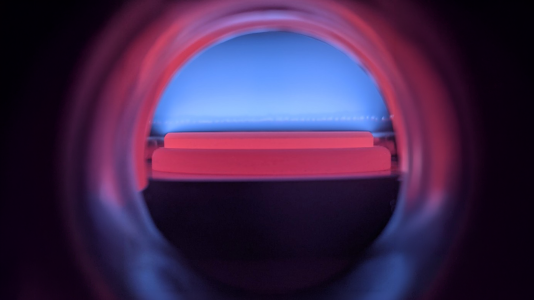
The U.S. Department of Energy's Argonne National Laboratory recently launched a new three-year, $1 million research project that plans to combine quantum information science with high-energy physics research to develop a new generation of quantum sensors based on diamond materials for higher-precision measurement and mapping of electromagnetic fields. Inside this plasma-filled vacuum chamber is the diamond substrate used to fabricate the diamond thin film (not shown in the image), within which the nitrogen-vacancy qubits are located. (Image courtesy of Nazar Delegan/Argonne National Laboratory.) In high-energy physics experiments, the precision of electromagnetic field measurements directly affects the reliability of experimental results. Whether analyzing the momentum of debris produced after particle collisions...
2026-08-18

Terra Clean Energy Receives Exploration Permit for Marysvale Uranium Project in Utah, USA
Terra Clean Energy Corp. recently announced that it has received the relevant permit from the Utah Division of Oil, Gas and Mining under the Utah Department of Natural Resources to carry out planned exploration work at its wholly-owned Marysvale Uranium Project. Under the approved work plan, the company will construct 5 drill pads to support subsequent diamond core drilling, and excavate 7 exploration trenches to expose and evaluate known uranium-bearing outcrops. Terra stated that this permit represents a significant milestone in advancing this historic uranium project. The trenching work will help the company's technical team map mineralized structures, collect samples, and validate existing geological interpretations. The results will...
2026-08-18

US FRIB Research Reveals Low-Energy Gamma-Ray Enhancement Originates from Nuclear Magnetic Transitions
An international research team led by the US Facility for Rare Isotope Beams (FRIB), with participation from Lawrence Livermore National Laboratory (LLNL) and other institutions, recently published findings in Nature that explain a long-standing question in nuclear physics: why some atomic nuclei emit anomalously high numbers of low-energy gamma rays. Image: FRIB Gamma rays are a type of electromagnetic radiation. Excited atomic nuclei release gamma rays during radioactive decay, gradually returning to lower, more stable energy levels. Over the past few decades, scientists have discovered that certain nuclei exhibit a low-energy enhancement phenomenon, where the number of low-energy gamma rays emitted exceeds expectations. However, this phenomenon is not universal, and its occurrence is theoretically difficult to predict.
2026-08-18
SwissFEL Achieves Ultralow-Temperature X-ray Observation of Quantum States
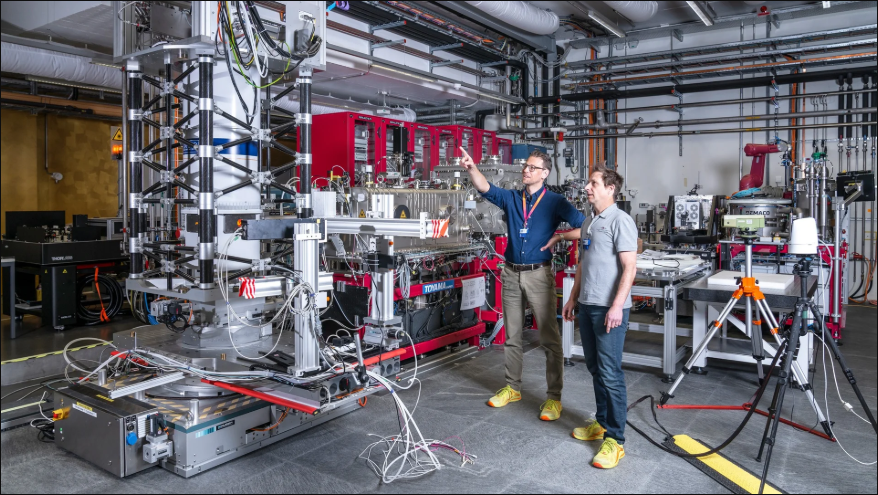
Researchers at the Paul Scherrer Institute (PSI) in Switzerland recently reported that the Cristallina experimental station of the Swiss Free-Electron Laser (SwissFEL) can now observe quantum states that only emerge at extremely low temperatures using X-ray scattering at temperatures close to absolute zero. Simon Gerber (left) and Bill Pedrini (right) at the Cristallina experimental station of SwissFEL. With the help of a custom-built cryostat connected to the beamline (far left), quantum states can now be studied at extremely low temperatures. Paul Scherrer Institute PSI/Markus FischerAccording to the team, they recently achieved a low temperature of 35 millikelvin in experiments...
2026-08-17
Fermilab Muon g-2 Experiment Sets New Direct Detection Limit on Muon Electric Dipole Moment
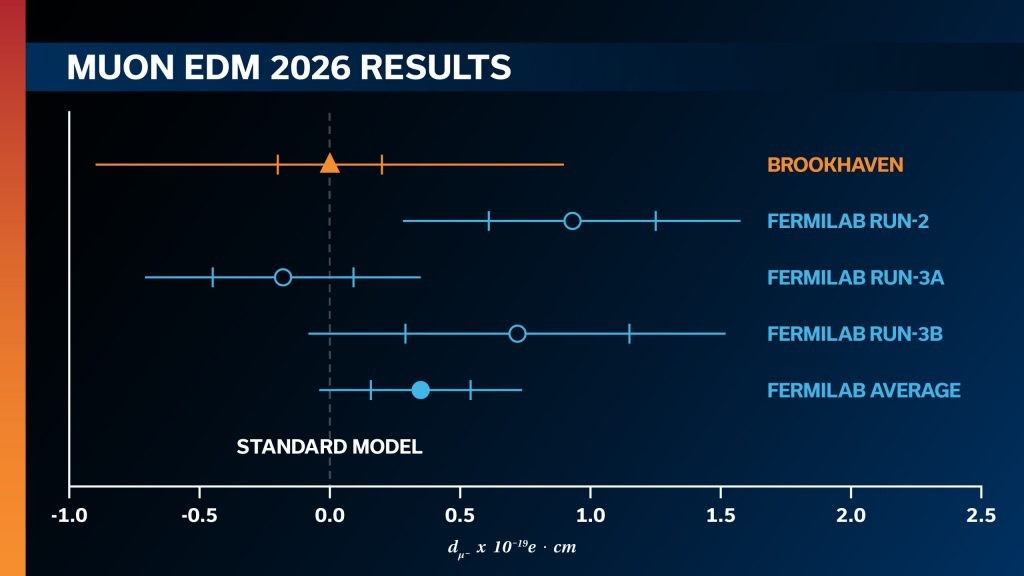
On August 12, 2026, the Muon g-2 Collaboration announced that a new analysis based on 25% of the data from the Muon g-2 experiment at the U.S. Department of Energy's Fermi National Accelerator Laboratory has produced the most sensitive direct measurement of the muon's electric dipole moment to date. The results show that if a muon electric dipole moment exists, its magnitude is below the current detection threshold of the experiment. The muon electric dipole moment values measured by Fermilab across different data-taking periods were compared with previous results from Brookhaven National Laboratory. The combined Fermilab value is consistent with zero (no observation). Although the experiment uses positive muons, results are typically reported for negative muons, which reverses the sign of the measured value...
2026-08-17
Argonne National Laboratory Unveils DONUT Tool to Accelerate Real-Time Analysis of X-ray Nanodiffraction Data
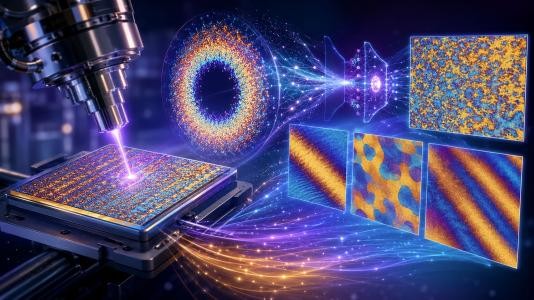
Researchers at the U.S. Department of Energy's Argonne National Laboratory have developed a new machine learning tool called DONUT to accelerate X-ray data analysis in experiments at the Advanced Photon Source (APS). The tool can process complex images generated by scanning X-ray nanodiffraction microscopy (SXDM) in real time during experiments, helping researchers more quickly determine internal structural changes in materials. DONUT stands for "Nanobeam Optical Diffraction based on Unsupervised Training," a physics-aware neural network. Its key feature is combining artificial intelligence methods with physical models of focused X-ray beam interactions with materials, allowing it to learn directly from experimental data without relying on pre-labeled training...
2026-08-17

South Korea's domestically developed lunar radiation detector to travel to the Moon aboard NASA commercial lunar lander
The Korea AeroSpace Administration (KASA) announced on August 17 that the Lunar Space Radiation Detector (LVRAD), independently developed by South Korea, will be mounted on a lander under NASA's Commercial Lunar Payload Services (CLPS) program to conduct observations of the radiation environment on the lunar south pole surface. The two sides signed the relevant implementation agreement on August 14. Under the agreement, KASA plans to complete the development of the flight model of the detector by next year and deliver the equipment to the United States in accordance with the NASA lunar lander mission schedule. NASA will be responsible for integrating the Korean-developed detector onto the commercial lunar lander and supporting its operation and data transmission on the lunar surface after launch. LVRAD consists of...
2026-08-17

US experiment reveals diamond melting behavior under high pressure, potentially advancing inertial confinement fusion research
Researchers at Lawrence Livermore National Laboratory published a new study in Nature Physics documenting the melting process of diamond at pressures approximately three times greater than those at Earth's core. The experiments showed that under high-pressure conditions, diamond floats in liquid metallic carbon, similar to how ice floats in water. This finding helps improve inertial confinement fusion experimental models and provides new evidence for understanding the potential "diamond rain" phenomenon inside ice giant planets such as Neptune and Uranus. The latest melting experiments confirmed that under high pressure, diamond floats in liquid metallic carbon, just as ice floats in a glass of water. (Concept image: James Wickboldt/LLNL) The research team stated...
2026-08-17

Oak Ridge National Laboratory marks 80 years of isotope research and production, with applications spanning medicine, industry, and scientific research
On August 2, 1946, the Clinton Laboratories in Oak Ridge, Tennessee, held the first formal ceremony to deliver reactor-produced radioactive isotopes. A shipment of carbon-14 was sent from there to the Barnard Free Skin and Cancer Hospital in St. Louis, Missouri. Over the past 80 years, this event has been regarded as the starting point of Oak Ridge National Laboratory's isotope research and production endeavors, and also marked the beginning of broader civilian applications for reactor-produced radioactive isotopes. After World War II, the U.S. scientific community began exploring peaceful uses of atomic energy, with radioactive isotopes becoming an important direction. As unstable variants of elements, radioactive isotopes release radiation during decay and can be used...
2026-08-15

NRC to Hold Online Public Meeting on Proposed Medical Use Licensing Rule
The U.S. Nuclear Regulatory Commission recently announced it will hold an online public meeting from 1:00 p.m. to 2:30 p.m. Eastern Time on August 20 to introduce the proposed rule aimed at reducing barriers to medical use licensing. The proposed rule was published in the Federal Register on July 27. During the meeting, NRC staff will outline the key provisions of the rule and related implementation activities, and answer questions from the public. The meeting is open to the public and will focus on regulatory processes related to medical use licensing, with the goal of explaining and discussing the proposed rule and subsequent implementation arrangements...
2026-08-16