
Search Results
Keyword:Ultra

International Researchers Successfully Develop the First Autonomous Thorium-229 "Nuclear Clock": Featuring Ultra-Strong Interference Resistance and a Fully Autonomous Closed-Loop Stable Operation Mechanism
Recently, the press office of TU Wien (Vienna University of Technology) announced that a team of scientists from Austria, Germany, and the Czech Republic has successfully developed the world's first nuclear clock based on the thorium-229 (chemical symbol ²²⁹Th) atomic nucleus. This nuclear clock possesses extremely high interference resistance and is capable of operating in a fully autonomous mode without external stabilization. The research team stated that, compared with traditional atomic clocks that operate using entire atoms, timekeeping using atomic nuclei can theoretically achieve higher measurement precision. Two years ago, they successfully controlled the transition process of the thorium-229 atomic nucleus for the first time, but to achieve extremely high-precision timekeeping, it was still necessary to solve the nuclear clock...
2026-10-08
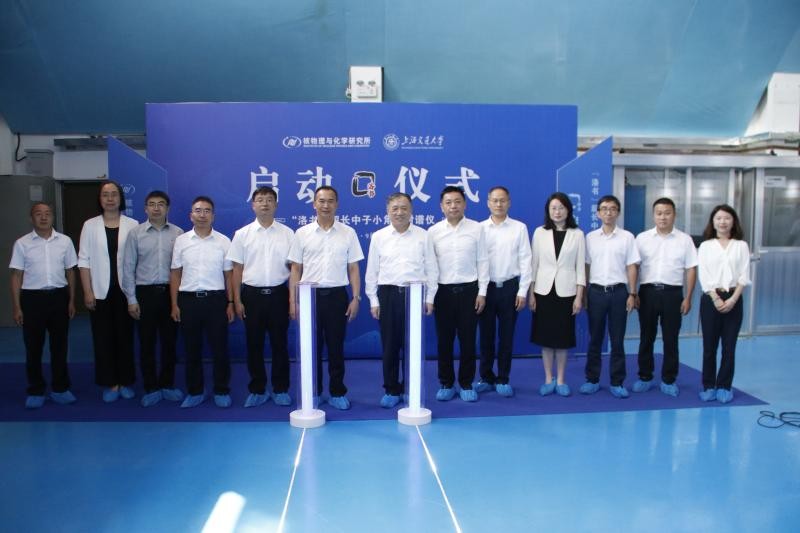
Shanghai Jiao Tong University's "Luoshu" Ultra-Long Neutron Small-Angle Scattering Spectrometer Officially Commissioned
On September 2, the launch ceremony for Shanghai Jiao Tong University's Luoshu Ultra-Long Neutron Small-Angle Scattering Spectrometer was held at the China Mianyang Research Reactor. Yang Zhenbin, Secretary of the Party Committee of Shanghai Jiao Tong University, Huang Ming, Vice President of the China Academy of Engineering Physics, and other leaders attended the event to jointly witness the official commissioning of this major scientific research facility. At the launch ceremony, Yang Zhenbin and Huang Ming jointly lit up the Luoshu Ultra-Long Neutron Small-Angle Scattering Spectrometer, marking its official commissioning. The Luoshu spectrometer was jointly built and collaboratively developed by Shanghai Jiao Tong University and the China Mianyang Research Reactor, with multiple core indicators reaching internationally advanced levels. It can broadly support research in fields such as aerospace, nuclear power and energy, biomedicine, new materials, and basic sciences, providing...
2026-09-10

U.S. Research Team Discovers Strong Ultrafast Optical Response Induced by Ionizing Radiation, Potentially Advancing Medical Imaging and Sensing Technologies
September 3 news, Stanford University and the U.S. Department of Energy's SLAC National Accelerator Laboratory research team used ultrafast electron and laser pulses to observe a strong ultrafast optical response triggered by ionization processes in semiconductor materials. The related research has been published in Nature Photonics. The researchers believe this discovery could provide new insights for radiography and sensing technologies, and also offer experimental evidence for understanding the fundamental behavior of materials under high-energy particle interactions. Radiation detection is a key technology in particle accelerators, scientific instruments, medical imaging, and security screening equipment. Existing detectors typically face a trade-off between signal strength and response speed: processes with stronger signals tend to be slower, while those with faster response may produce weaker signals...
2026-09-08

No Evidence of Mirror Neutrons Found in Swiss PSI Ultracold Neutron Experiment
The Ultracold Neutron Physics Group at the Paul Scherrer Institute (PSI) in Switzerland recently stated that its research team found no evidence of spontaneous transformation of ordinary neutrons into mirror neutrons in a high-precision experiment. The researchers said the result essentially rules out the main parameter space previously suggested for anomalous neutron-mirror neutron oscillation signals, and also weakens the possibility that mirror neutrons could be a component of dark matter. Bernhard Lauss (left) and Géza Zsigmond examined approximately 2.5 billion neutrons at the ultracold neutron source at the Paul Scherrer Institute (PSI). They essentially ruled out the hypothesis of spontaneous transformation of neutrons into mirror neutrons. (Image courtesy of Paul Scherrer Institute PSI/Ma...
2026-09-07

Russia masters production technology of ultra-pure germanium for gamma detectors
The Giredmet Research Institute, part of Rosatom, recently announced that its researchers have developed technology for producing high-purity germanium (HPGe) for gamma-ray detectors. This breakthrough is expected to replace imported crystals and promote the formation of a complete production cycle for detector equipment within Russia. According to reports, experts at Giredmet have designed and manufactured experimental equipment, and based on this, developed a process for preparing ultra-high-purity germanium single crystals. The purity of the germanium material reaches at least 7N, i.e., 99.99999%, equivalent to only one impurity atom per 10 million atoms of the primary material. The institute stated that the first batch of experimental samples has been obtained, verifying the effectiveness of the adopted deep germanium purification method in achieving the purity level required for detector applications.
2026-09-07

German Team Achieves Ultrafast Shaping of Extreme Ultraviolet Pulses Using High-Density Helium Gas
August 20, 2026, the international team led by researchers from the Max Planck Institute for Nuclear Physics (MPIK) in Heidelberg announced that they have utilized atomic gas as a rapidly switchable time-varying lens to control the beam shape and spectrum of intense high-frequency laser pulses. This achievement is expected to provide a new pathway for the fine control of extreme ultraviolet (XUV) and X-ray pulses, and may serve research directions such as improved spectroscopic methods, control of chemical reactions, and quantum computing. Extreme ultraviolet light can provide important tools for studying atomic-scale processes. With the development of free-electron lasers, researchers have been able to generate ultrashort, high-intensity XUV light pulses, but how to manipulate them like...
2026-08-31

Tescan Launches MIRA XR Ultra-High-Resolution Scanning Electron Microscope for Materials Characterization and Failure Analysis Applications
Tescan recently launched the MIRA XR ultra-high-resolution scanning electron microscope system, targeting materials characterization needs in fields such as battery technology, metallurgy, and advanced materials science. Positioned between the Tescan MIRA and Tescan CLARA, the system aims to deliver higher resolution, enhanced surface sensitivity, and a more streamlined workflow, serving applications including R&D laboratories, industrial quality control, and failure analysis. According to reports, the MIRA XR employs BrightBeam™ technology and a single high-efficiency axial detector to improve surface signal acquisition under field-free imaging conditions, making it suitable for beam-sensitive materials and magnetic samples while reducing the need for sample preparation steps such as surface coating. The system also features an aperture-free column design that minimizes manual aperture selection and adjustment steps, allowing operators to focus more on sample observation and data analysis.
2026-08-26

Russian Far Eastern Federal University Develops Ultrafast Ceramic Scintillators for Rapid Ionizing Radiation Detection
On August 21, 2026, scientists at the Russian Far Eastern Federal University, with support from the Russian Science Foundation, are developing ceramic materials for ultrafast detection of ionizing radiation. The results could be used in the future for medical diagnostics, baggage and cargo security screening, radiation monitoring, and scientific equipment requiring fast, precise radiation detection. The project, titled "Ultrafast Ceramic Scintillators for Ionizing Radiation Detection," is led by Anastasia Vonovskikh, a researcher at the Research and Education Center for Advanced Ceramic Materials, Department of Industrial Safety, Polytechnic Institute, Far Eastern Federal University. Scintillators are a class of materials that emit light when exposed to ionizing radiation. Detectors record these light signals to determine radiation intensity and energy. Currently, most related equipment uses single-crystal scintillators, but their production typically requires significant energy and resource inputs. The Far Eastern Federal University team proposes special ceramic materials as an alternative, aiming to improve detection speed and efficiency, making them more suitable for detecting trace amounts of radiation.
2026-08-25
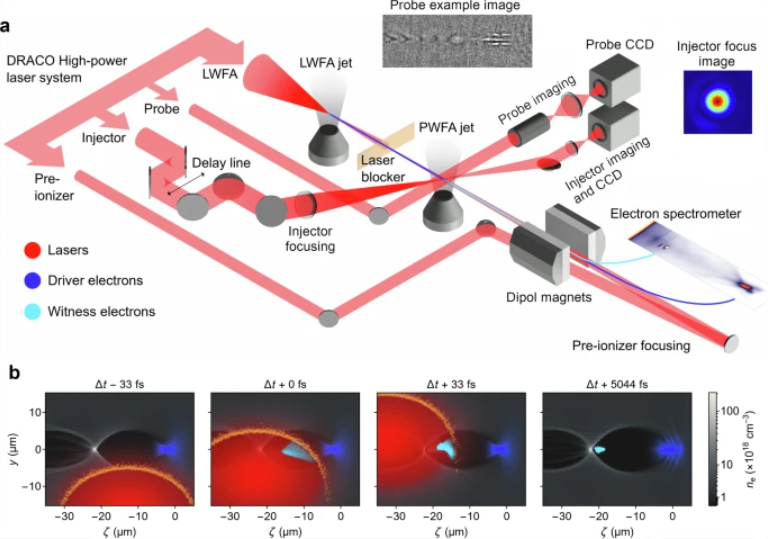
German research team achieves ultra-compact plasma photocathode injection
A research team from institutions including the Helmholtz-Zentrum Dresden-Rossendorf in Germany has demonstrated an ultra-compact plasma photocathode injection scheme integrated into a hybrid plasma wakefield accelerator on the DRACO laser facility. The study utilized a 150 TW-class laser system to drive a laser wakefield accelerator (LWFA), generating high-peak-current electron beams, which in turn drove a subsequent particle beam wakefield accelerator (PWFA), completing the generation and acceleration of witness electron beams within millimeter-scale plasma structures. Plasma wakefield accelerators can produce accelerating fields far exceeding those of conventional radiofrequency linear accelerators, but how to obtain high-quality, high-brightness electron beams in compact devices...
2026-08-18
SwissFEL Achieves Ultralow-Temperature X-ray Observation of Quantum States
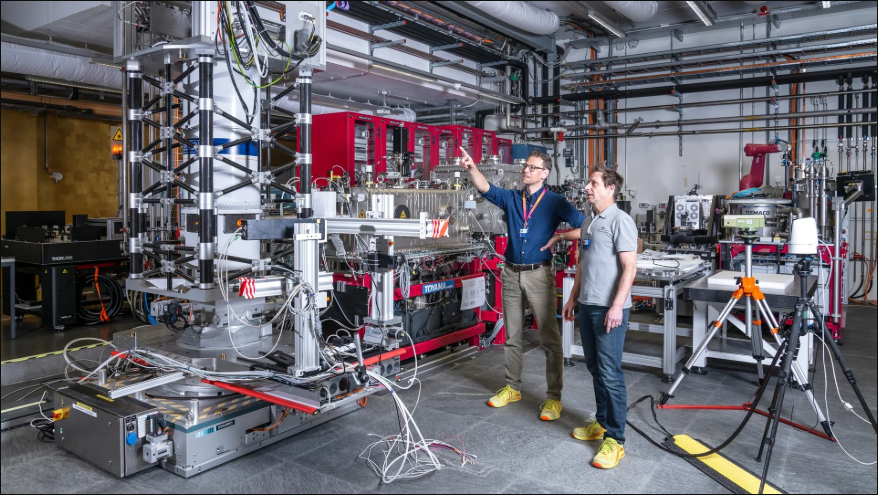
Researchers at the Paul Scherrer Institute (PSI) in Switzerland recently reported that the Cristallina experimental station of the Swiss Free-Electron Laser (SwissFEL) can now observe quantum states that only emerge at extremely low temperatures using X-ray scattering at temperatures close to absolute zero. Simon Gerber (left) and Bill Pedrini (right) at the Cristallina experimental station of SwissFEL. With the help of a custom-built cryostat connected to the beamline (far left), quantum states can now be studied at extremely low temperatures. Paul Scherrer Institute PSI/Markus FischerAccording to the team, they recently achieved a low temperature of 35 millikelvin in experiments...
2026-08-17

Russia's Atommash Commissions Ultrasonic Weld Inspection Robot to Boost NPP Equipment Testing Efficiency
Atommash, a plant under the mechanical engineering division of Russia's State Atomic Energy Corporation (Rosatom), has recently commissioned a new ultrasonic inspection robot for welded joints, used for weld quality checks on large nuclear power equipment such as nuclear reactors and steam generators. The plant is located in Rostov Oblast, Russia. The new equipment employs two scanning modes and can identify weld defect types and locate defect coordinates. Compared with traditional inspection methods involving manual probe movement, the robot can automatically perform scanning on components with complex geometries, increasing inspection speed by approximately 30% while reducing the need for manual work in hard-to-reach areas. At present, Atommash already operates...
2026-08-11

MIT Develops Ultrafast X-ray Thermometry Method to Observe Heat Transfer in Multilayer Chip Structures
Researchers at the Massachusetts Institute of Technology (MIT) have developed a new method for observing how heat transfers through multilayer materials, which can be used to precisely measure heat flow variations inside electronic devices such as computer chips. The findings have been published in Nature Communications. As computer chips continue to shrink in size and power density keeps rising, device overheating has become a major factor limiting performance improvements. Traditional heat flow measurement methods face limitations when dealing with the multilayer structures of real electronic devices—for example, the commonly used time-domain thermoreflectance method struggles to distinguish heat transport in different material layers, while infrared imaging and other approaches also fail to capture rapid changes at microscopic scales. To address this issue...
2026-08-06

Colorado State University produces first ultracold neutral plasma with electron temperature below 1 kelvin
Researchers at Colorado State University have, for the first time, produced an ultracold neutral plasma by combining laser cooling techniques with strong magnetic fields. Measurements show that the electron temperature in this plasma is less than 1 kelvin above absolute zero, making it one of the lowest electron temperatures ever measured in a plasma. The research was published in Physics of Plasmas. The new method proposed in the paper helps test plasma theories under more controllable experimental conditions and improve computational models of plasma behavior in extreme environments. The researchers believe this achievement could contribute to future fusion energy...
2026-08-05

Study Shows Sustained Deuterium Fusion in Palladium and Titanium Metal Foils at Ultra-Low Energies
U.S. researchers have observed a low-energy deuterium fusion phenomenon in thin palladium and titanium metal foils: when the incident deuteron energy drops to levels where fusion reactions are generally expected to weaken significantly or even nearly cease, the reactions continue to occur. Experiments show that as incident energy decreases, the fusion rate does not continue to decline exponentially but instead enters a plateau region below approximately 2 keV. At the lowest detectable energy, the measured low-energy fusion rate exceeds predictions from isolated-nucleus models by more than 10^18 times. Image courtesy of Marina Light/University of California, Davis. The related research was conducted by teams at the University of California, Davis and Lawrence Berkeley National Laboratory...
2026-08-04

Zhongji Flash e-Flash 200A Enters Innovative Medical Device Special Review Program
Recently, the public notice period for the review results of applications for the Innovative Medical Device Special Review Program by the Center for Medical Device Evaluation of the National Medical Products Administration has concluded. The ultra-high dose rate electron beam radiotherapy system (e-Flash 200A), independently developed by Zhongji Flash Medical Technology Co., Ltd., has officially entered the Innovative Medical Device Special Review Program. According to reports, the e-Flash 200A is China's first ultra-high dose rate electron beam FLASH radiotherapy device and had previously been included in the "Global New" green channel. Its entry into the Innovative Medical Device Special Review Program signifies further recognition of the product's technological innovation and clinical application value. The system is designed for superficial tumor radiothe...
2026-08-04