
Search Results
Keyword:fission

Gigawatt-Scale Computing Meets Megawatt-Scale Fission: Examining the Underlying Assets and Geopolitical Restructuring Behind Asia-Pacific's Nuclear Renaissance
As human civilization enters the "century of electricity," large AI models and hyperscale data center clusters are devouring power grids at an astonishing pace. When intermittent renewable energy cannot satisfy the stringent demand of high-load data centers for absolutely stable baseload power, nuclear energy—long marginalized or viewed with caution in the Asia-Pacific region—is now experiencing an unprecedented rational return. According to the Asia-Pacific energy observations published by Ben Carrozzi, a partner at international law firm Norton Rose Fulbright, data center electricity demand in Southeast Asia is projected to surge fourfold between 2025 and 2035, rising from 2.6 gigawatts (G...
2026-10-28

NASA's SR-1 Freedom deep-space nuclear reactor progresses smoothly, planned to set sail in 2028
Recently, the National Aeronautics and Space Administration (NASA) announced that its Space Reactor-1 (SR-1) Freedom has achieved a key breakthrough in the development of nuclear power modules and has reached an important contract consensus with partners. The reactor will become the first spacecraft to demonstrate nuclear fission power beyond Earth orbit, with launch planned for late 2028 en route to Mars. It is understood that Sierra Lobo will provide the closed Brayton cycle power conversion system for SR-1 Freedom, responsible for converting the thermal energy generated by the fission reactor into electricity to drive the nuclear electric propulsion system. The power conversion system will be deeply integrated with the fission reactor designed and developed by the U.S. Department of Energy (DOE) Idaho National Laboratory (Idaho National Lab...
2026-10-21

Unit 1 of Bangladesh's Rooppur Nuclear Power Plant Achieves First Criticality, Realizing First Nuclear Fission Chain Reaction
Unit 1 of the Rooppur Nuclear Power Plant, Bangladesh's first nuclear power plant, officially initiated its first nuclear fission reaction on the afternoon of October 11, marking a breakthrough milestone for the country's first major nuclear energy project. Md Anwar Hossain, Permanent Secretary of the Ministry of Science and Technology of Bangladesh, confirmed to the media that, after obtaining formal approval from the nuclear safety regulatory authority, the unit successfully initiated a self-sustaining nuclear fission chain reaction at approximately 3:34 p.m. that day. Hossain stated that the on-site commissioning team conducted the fission reaction startup operation at Unit 1 for the first time that day, and the entire startup process proceeded very smoothly...
2026-10-12
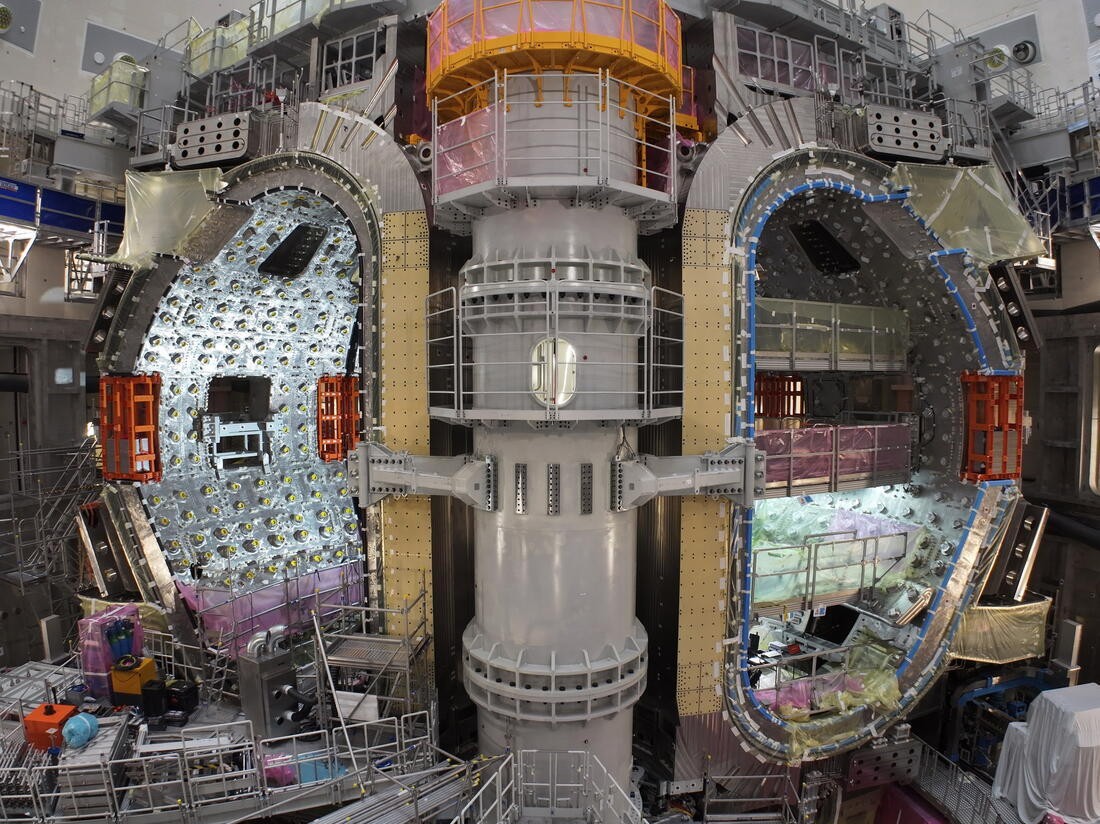
French Nuclear Safety and Radiation Protection Authority Approves Exemption of ITER Vacuum Vessel from Fission Pressurized Equipment Regulation
The French Nuclear Safety and Radiation Protection Authority (ASNR) has formally issued a regulatory ruling, approving the application by the International Thermonuclear Experimental Reactor (ITER) Organization to exclude the Vacuum Vessel, a core component of the ITER tokamak device, from the scope of regulation under the French and European Nuclear Pressure Equipment Directive (ESPN). This breakthrough ruling marks the beginning of key fusion reactor components breaking free from the regulatory framework derived from traditional fission reactors. Prior to this decision, the ITER Vacuum Vessel had long been classified as nuclear pressure equipment. This classification originated from the management practices of traditional light-water fission reactors, whose underlying logic presumes internal pressure as the primary engineering load on the structure. However...
2026-10-11

Unit 1 of Bangladesh's Rooppur Nuclear Power Plant Approved to Initiate Nuclear Fission Reaction
Recently, the Bangladesh Atomic Energy Regulatory Authority (BAERA) issued a final license to Unit 1 of the Rooppur Nuclear Power Plant (Rooppur NPP) located in Ishwardi, Pabna, allowing it to initiate a controlled nuclear fission reaction. This is a key step for the 1,200-megawatt reactor toward commissioning. Saikat Ahmed, project focal point of the Rooppur Nuclear Power Plant, told New Age that the license will allow the reactor to reach the B2 stage and achieve first criticality. First criticality refers to the initiation of a controlled, self-sustaining...
2026-10-09

German Research Team Completes First Phase Analysis of Chernobyl "Hot Particles": Nuclear Fuel Crystal Structure Still Exhibits Unexpectedly High Chemical Stability After 40 Years
Nearly 40 years after the 1986 Chernobyl Nuclear Power Plant accident, a research team from Leibniz University Hannover and Helmholtz-Zentrum Dresden-Rossendorf (HZDR) in Germany has completed the world's first synchrotron radiation X-ray-based precision crystal phase analysis of 6 micron-sized highly radioactive fragments (commonly known in the industry as Hot Particles) ejected from the destroyed reactor. The related breakthrough research findings have been officially published in the top-tier journal in environmental and radioecology, the Journal of Hazardous Materials.
2026-10-07

California Signs Two Bills to Reshape Advanced Nuclear Fission and Fusion Energy Strategy
California Governor Gavin Newsom recently signed two bills aimed at comprehensively advancing the state's nuclear energy development by reassessing advanced nuclear fission technology and establishing a strategic plan for nuclear fusion. In the field of nuclear fission, Assembly Bill 2647 (A.B. 2647) requires the California Energy Resources Conservation and Development Commission (CEC) to conduct a formal assessment of advanced nuclear energy technologies by January 1, 2028. The bill, introduced by Assemblymember Lisa Calderon, directs the CEC to comprehensively consider factors such as cost, grid reliability, fuel cycle, and public health in determining whether new nuclear power plants can help California achieve its 2045 zero-carbon electricity goal. Calderon stated that given current grid demands, California needs to reassess the role of nuclear energy in ensuring a stable and clean electricity supply based on modern technology.
2026-10-04
Deep Fission Discloses Safety Design Agreement for Kansas Nuclear Pilot Project
Deep Fission, the company building a nuclear reactor one mile underground in Parsons, Kansas, made its federally approved safety report public on Monday. The U.S. Department of Energy approved the company's safety design for its Gravity nuclear reactor in July of this year. A press release stated that the company publicly released the report, with only a very small number of details involving safety privacy redacted. Liz Muller, co-founder and CEO of Deep Fission, said in the press release that the company disclosed the complete Nuclear Safety Design Agreement because they believe the public has the right to see the true safety...
2026-09-18
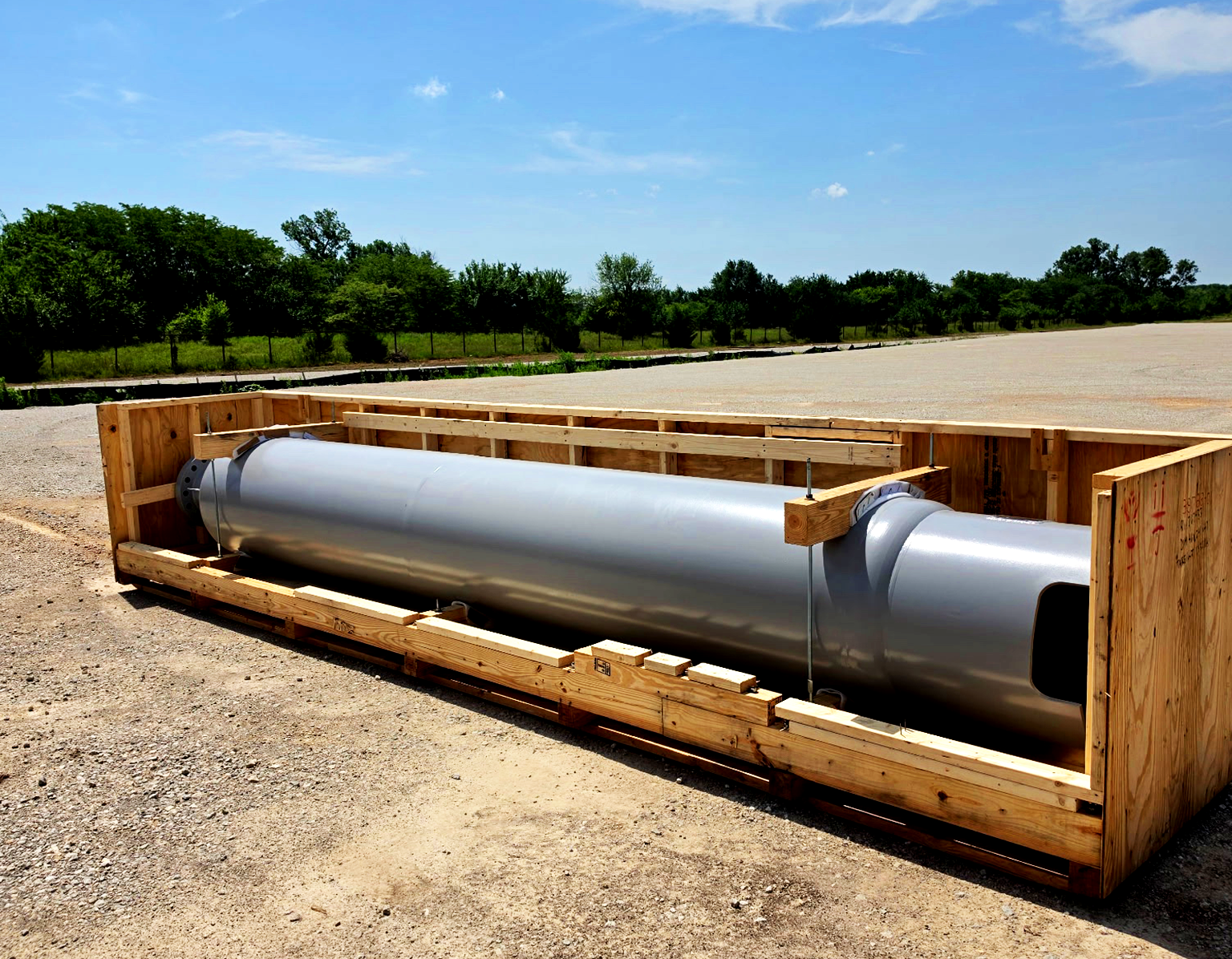
US-based Deep Fission Completes Full-Scale Reactor Vessel Deployment and Retrieval Demonstration Using Commercial Drilling Equipment
On September 3, 2026, advanced nuclear energy development company Deep Fission, Inc. (stock ticker: FISN) announced that it had completed a deployment and retrieval demonstration of a full-scale non-nuclear prototype reactor vessel using standard commercial drilling and hoisting equipment. The company is developing a technology pathway that deploys small modular pressurized water reactors in boreholes approximately 1 mile deep underground. In this demonstration, a commercial drilling and hoisting team lowered a 20-foot-long prototype reactor vessel into a 34-inch-diameter, 100-foot-deep borehole, and after completing alignment, retrieved it to the surface. Deep Fission stated that the equipment used in the demonstration was all standard equipment already in commercial...
2026-09-11

France to Invest €18 Million in Nuclear Fission Research Program
The French National Centre for Scientific Research (CNRS) recently announced the launch of a new scientific research program on nuclear fission. The program will run for six years, from 2026 to 2031, with a total funding of €18 million. Financed by the French government under the France 2030 initiative and coordinated by the French National Research Agency (ANR), the program aims to strengthen the scientific foundation required for the development of current and future nuclear fission technologies. Under the arrangement, approximately half of the funding will be allocated to human resources development, including doctoral and postdoctoral projects; the remaining funds will be directed toward research equipment and infrastructure, covering particle accelerators, experimental reactors, and radiochemistry laboratories, among others....
2026-09-08
U.S. Plans to Launch Nuclear Fission-Powered Spacecraft to Fly by Mars by End of 2028
The National Aeronautics and Space Administration (NASA) is advancing the Space Reactor-1 "Freedom" (SR-1 Freedom) mission, with the goal of launching a nuclear fission-powered spacecraft by the end of 2028 to validate deep-space nuclear electric propulsion technology. According to existing mission documentation, the mission plans to fly by Mars in 2029 and deploy the SkyFall payload. The SR-1 Freedom is neither a fusion spacecraft nor a crewed Mars vehicle. Its core experiment is to operate a small uranium fission reactor, an energy conversion system, and Hall-effect thrusters in coordination beyond Earth orbit, accumulating engineering data for future higher-power deep-space missions...
2026-08-24

Astrotech Plans Commercial Lunar Power Facility, Evaluating Nuclear Fission Power Supplement Options
Astrotech Corporation announced on August 11 that its wholly-owned subsidiary, Lunar Power & Light (LP&L), plans to develop a commercial power generation, storage, and distribution network in high-illumination regions near the lunar poles to provide lunar power services for future government and commercial customers. The company also stated that the plan remains in its early stages, with further progress contingent on technology validation, financing, customer commitments, launch conditions, and relevant government authorizations. According to LP&L's vision, the proposed power grid would consist of distributed elevated solar towers, sun-tracking systems, utility-scale and local battery storage, autonomous control...
2026-08-12

Deep Fission Details 'One-Mile-Deep PWR' Roadmap at Canaccord Conference, Targeting First Commercial Operation by End of 2027
On August 11, Deep Fission (FISN) unveiled a differentiated nuclear commercialization pathway at Canaccord Genuity's 46th Annual Growth Conference: rather than reinventing nuclear fission technology, the company aims to deploy mature pressurized water reactors in underground boreholes approximately one mile deep. CEO Liz Muller emphasized that the core approach is to change where reactors are deployed, not to adopt an entirely new reactor physics model. Given that PWR technology has been used in commercial nuclear power for decades, the company hopes to shorten the validation cycle by leveraging mature technology and avoid the new fuel, new material, and new design licensing hurdles faced by some advanced nuclear projects. According to the company's plan...
2026-08-12

Shenju Nuclear Energy Unveils "Jinwu-1" Spherical Torus Fusion-Fission Hybrid Reactor Design
Shenju (Sichuan) Nuclear Energy Co., Ltd. has unveiled the first-generation device, the Jinwu-1 design, which adopts the spherical torus fusion-fission hybrid reactor technology pathway, driving a subcritical nuclear energy system with a compact fusion neutron source to achieve functions such as energy amplification, fuel breeding, and transmutation of long-lived nuclides. According to the design, Jinwu-1 uses a 50 MW-class fusion power as the conceptual design baseline, employing high-temperature superconducting magnets, a replaceable center column, and a modular subcritical nuclear energy zone. Its fusion core has a major radius of approximately 1.5 meters, with the goal of delivering approximately 40 MW of fusion neutron power at 14.1 MeV energy, serving as an industrial-grade neutron source. In terms of system design, Jinwu-1 amplifies fusion neutron energy through a subcritical fission blanket...
2026-08-11
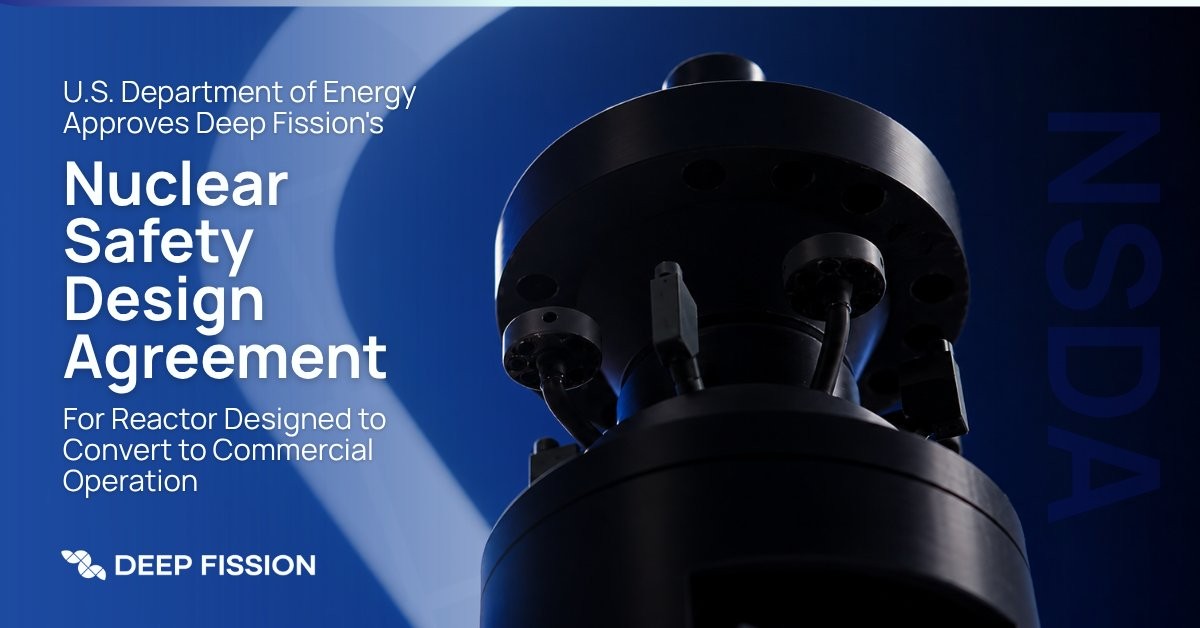
US DOE Approves Nuclear Safety Design Agreement for Deep Fission Underground SMR
Deep Fission, a US advanced nuclear energy company, announced on August 6 that the US Department of Energy (DOE) has approved the Nuclear Safety Design Agreement (NSDA) for its Gravity reactor. The company stated that this milestone means its reactor design meets the requirements for continued advancement under the DOE's Reactor Pilot Program. Deep Fission is developing a small modular pressurized water reactor concept, with plans to place the reactor in a borehole approximately 1 mile, or about 1.6 kilometers, underground. The approved Nuclear Safety Design Agreement will serve as the safety framework for subsequent reactor development work. According to the company's plans, the project will proceed into the DOE authorization process...
2026-08-07