

U.S. SYNOPTICS Produces Large-Size Yb:YLF Crystal for Inertial Confinement Fusion Laser Systems
On August 19, SYNOPTICS, a subsidiary of Northrop Grumman, announced that it had successfully grown and harvested a large-size ytterbium-doped yttrium lithium fluoride crystal, namely a Yb:YLF crystal ingot. The crystal measures approximately 127 millimeters at its widest point, with a diameter three times the industry standard. SYNOPTICS stated that as laser engineering continues to expand toward higher efficiency and higher power, the demand for gain media with larger apertures and larger dimensions continues to grow. The Yb:YLF crystal produced this time is approximately 20% larger than the largest crystal the company had previously grown, and approximately 50% larger than the company's conventional product size. Kevin Stevens, General Manager of SYNOPTICS, stated that yttrium lithium fluoride is a commonly used host material for laser-active rare-earth ions, and scaling up the growth of YLF crystals will help laser engineers continue to raise the upper limit of achievable laser output power. He said that such materials are of significant importance for applications including directed energy, inertial confinement fusion, and industrial laser systems. Stevens also stated that Yb:YLF crystals can be used in applications requiring reduced thermal lensing effects and enhanced pulsed energy storage capability, while also leveraging their natural birefringent host to achieve polarization characteristics. According to information recently released by SYNOPTICS, some of the crystals will be used in the high-energy laser system at the German Electron Synchrotron Research Center (DESY) to support its inertial confinement fusion energy research. The company is currently studying the feasibility of further scaling up the size of Yb:YLF crystals, and plans to extend the relevant processes to other rare-earth-ion-doped YLF crystals, including holmium, thulium, and neodymium doping systems.
2026-08-21

Mellifluous Fusion and Advaiya Solutions Partner to Deliver AI and Business Technology Solutions for the Fusion Energy Industry
On August 19, Mellifluous Fusion, a fusion energy marketing company, signed a cooperation agreement with Advaiya Solutions, a business technology company, to provide solutions related to business applications, artificial intelligence development, and deployment for the rapidly growing fusion energy industry. Under the agreement, the collaboration will focus on enhancing operational efficiency, organizational coordination, and responsiveness in the fusion energy supply chain through integrated systems and AI tools. As fusion energy companies, suppliers, and supporting service systems expand rapidly, digital business systems and AI applications are seen as key to supporting the industry's large-scale development...
2026-08-20

Aomori Prefecture in Japan to Apply as Candidate Site for Nuclear Fusion Power Generation Demonstration Facility
On August 19, Soichiro Miyashita, Governor of Aomori Prefecture, stated that the prefecture will apply as a candidate site for a nuclear fusion power generation demonstration facility once relevant preparatory work is completed. Starlight Engine, a Japanese nuclear fusion startup, is currently soliciting candidate sites from prefectures and government-designated cities, with plans to conduct field surveys of promising candidates as early as this autumn. Starlight Engine plans to finalize the construction site by 2028, launch the FAST nuclear fusion power generation demonstration project in 2035, and conduct power generation demonstrations in 2038. The application deadline for site selection is October. Aomori Prefecture stated that it will consult with Rokkasho Village and, after preparing the application documents, formally submit the application.
2026-08-20
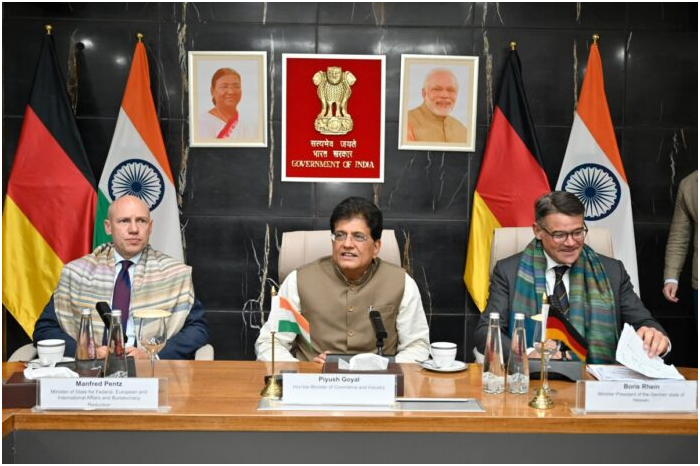
India and Germany's Hesse Explore Clean Energy Cooperation, with Discussions Covering Laser-Based Nuclear Fusion Research
On August 19, India's Minister of Commerce and Industry Piyush Goyal held talks with Boris Rhein, Minister-President of the German state of Hesse, to discuss strengthening economic and technological cooperation between India and Hesse. Manfred Pentz, Minister for Federal and European Affairs, International Affairs and Deregulation, along with a German business delegation, attended the meeting. The talks covered several emerging and high-growth sectors, with energy-related discussions focusing on clean energy and future technologies. The two sides discussed Hesse's initiatives in next-generation energy technologies, including laser-based...
2026-08-20

General Fusion Announces Business Update: LM26 Plasma Heated to Approximately 0.72 keV
General Fusion released a business update on August 18, disclosing its latest progress in fusion energy technology validation, commercial partnerships, and financing arrangements. The company went public on Nasdaq in July 2026 under the ticker symbol GFUZ. General Fusion stated that it entered the public market with approximately $150 million in cash following the completion of its business combination with Spring Valley Acquisition Corp. III. The funds include net transaction proceeds from private placement and trust capital, and are planned to support the Lawson Machine 26 (LM26) project and drive the completion of multiple...
2026-08-19

Thea Energy Completes Series B Extension to Advance Stellarator Fusion Plant Deployment
Thea Energy, Inc. announced on August 18 that it has completed an extension of its Series B financing round, with new investors including Brevan Howard Macro Venture, Aloniq, ALJ Investments, Beyond Earth Ventures, and other global strategic investors. The company stated that the new funds will be used to advance the engineering and commercial deployment of its stellarator fusion technology. Thea Energy had previously announced the completion of a $100 million Series B round, led by the U.S. Innovative Technology Fund (USIT) under Thomas Tull. The funds are primarily intended to expand magnet manufacturing capacity and build a second facility in northern New Jersey.
2026-08-19
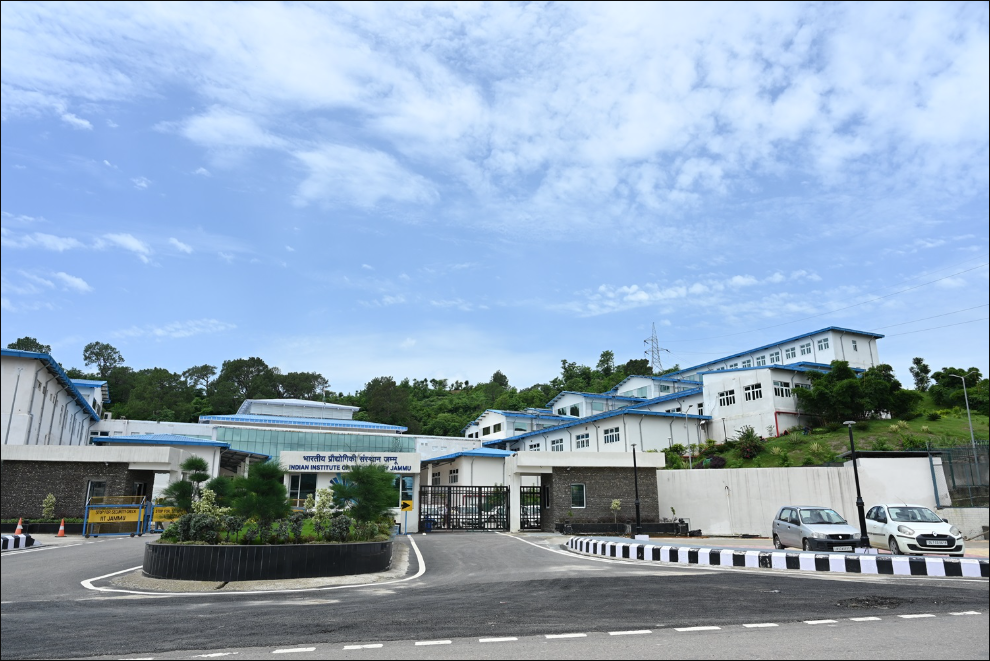
Indian research team uses supercomputer to track microscopic mechanisms of turbulence in dusty plasmas
Researchers at the Indian Institute of Technology Jammu (IIT Jammu), in collaboration with the Indian Institute of Technology Kanpur (IIT Kanpur), used supercomputer simulations to study the origin of chaos in dusty plasmas. By tracking the motion of millions of individual particles, the study revealed how turbulent energy is transferred from large-scale vortices to microscopic thermal motion of particles, providing a new computational perspective for nuclear fusion plasma research and astrophysical process analysis. Plasma is often referred to as the fourth state of matter. Unlike solids, liquids, and gases, atoms in plasma are ionized, forming a system composed of positively charged ions and negatively charged electrons. When tiny solid dust particles enter the plasma, these particles absorb electrons and become negatively charged, subsequently undergoing complex interactions with surrounding particles to form dusty plasma.
2026-08-19

ASP Isotopes Subsidiary Evaluates Metal Hydrofluorination and Fluorination Project in Namibia
ASP Isotopes Inc. recently announced that its wholly-owned subsidiary, Quantum Leap Energy LLC, is evaluating metal conversion opportunities in Namibia, with work focusing on technologies and processes required for critical stages of the fission and fusion nuclear fuel cycles. According to the disclosure, the evaluation includes plans to construct a pilot-scale hydrofluorination and fluorination facility in the Walvis Bay area of Namibia. Public environmental and social impact assessments and consultation procedures for the project have already been initiated. The proposed facility will be used to develop, test, and demonstrate metal hydrofluorination and fluorination processes. In accordance with Namibian regulatory requirements, relevant public consultation notices have been published through customary local channels. The company...
2026-08-19
UK Atomic Energy Authority spins out Singular Machines
The UK Atomic Energy Authority (UKAEA) has recently spun out Singular Machines, a UK engineering automation company. The company is commercializing artificial intelligence technologies originating from fusion engineering R&D scenarios and has secured strategic investment and new industry contracts. According to information released by UKAEA on August 17, Singular Machines has completed a round of strategic investment. The round was led by the UK Innovation & Science Seed Fund and Oxford Science Enterprises, with participation from global engineering firm Arup and Japan's Miraiso...
2026-08-18

Russia to Develop General Safety Rules for Controlled Thermonuclear Fusion Facilities
The Federal Environmental, Industrial and Nuclear Supervision Service of Russia (Rostekhnadzor) has completed the development of the draft federal norms and rules in the field of atomic energy use, "General Provisions for Ensuring the Safety of Controlled Thermonuclear Fusion Facilities," and has been soliciting comments and suggestions on the results of the draft review since August 17, 2026, with a feedback deadline of September 17, 2026. According to the draft, the document applies to controlled thermonuclear fusion facilities equipped with thermonuclear reactors or thermonuclear devices. The scope of application includes thermonuclear devices with a neutron production intensity exceeding 10²⁰ neutrons per second, or, in pulsed operation with a single pulse of less than 1 second, exceeding 10²⁰ neutrons per pulse, as well as...
2026-08-17
U.S. Fusion Company Discloses Texatron Platform Progress and Capital Markets Plans
American Fusion disclosed to shareholders on August 14 the latest developments in the global fusion energy industry, data center electricity demand in Texas, and the company's capital markets arrangements. The company stated that its Texatron fusion engine under development remains in the testing and engineering validation phase, and whether it can be used for commercial power supply in the future depends on multiple conditions, including test plans, regulatory approvals, financing, scaled production, and commercialization progress. American Fusion stated that its long-term goal is to develop the Texatron platform into a scalable distributed power source and explore supplying electricity to data centers, hospitals, defense facilities, industrial facilities, and other customers through a power-as-a-service model.
2026-08-17
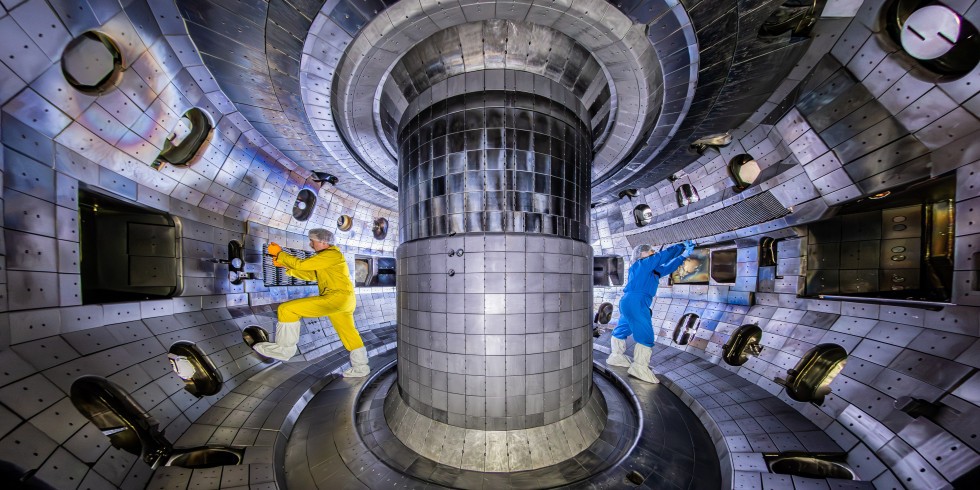
Machine learning framework predicts micro-displacements of DIII-D fusion device coils
Researchers at the U.S. Department of Energy's (DOE) Thomas Jefferson National Accelerator Facility (Jefferson Lab) and collaborating teams have developed a machine learning framework that can predict subtle changes in critical fusion device hardware before the next experiment begins. The method targets the DIII-D National Fusion Facility in San Diego, and the findings have been published in the journal Machine Learning with Applications. Interior of the DIII-D National Fusion Facility tokamak. (Image courtesy of General Atomics) DIII-D is a tokam...
2026-08-17
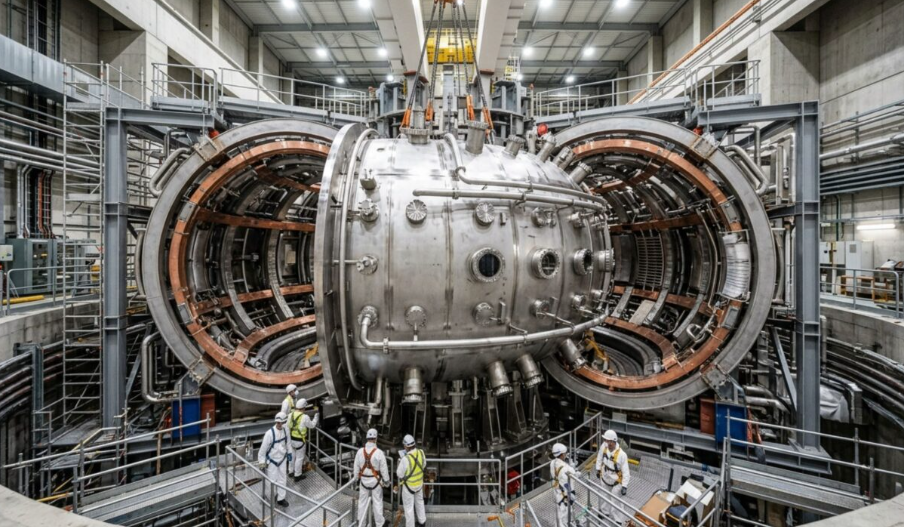
ITER Tokamak Advances Assembly in France, Fusion Experiment Targets 150 Million Degree Celsius Plasma
The ITER tokamak being assembled in southern France is one of the most closely watched large-scale experimental devices in global nuclear fusion research. The machine weighs approximately 23,000 tonnes in total and adopts a donut-shaped toroidal structure, using strong magnetic fields to confine high-temperature plasma, with the goal of replicating on Earth the conditions for fusion reactions that occur inside stars. Its plasma volume is approximately 830 cubic meters, far exceeding previous tokamak devices, and it is therefore expected to validate the key physics and engineering technologies required for future commercial fusion reactors. ITER adopts the toroidal tokamak structure because charged particles can move along toroidal paths under strong magnetic fields, thereby minimizing direct contact with the device's inner walls...
2026-08-14

Marvel Fusion, Colorado, and Siemens Energy Sign Letter of Intent to Advance Laser-Driven Fusion Energy Cooperation
Marvel Fusion, the U.S. State of Colorado, and Siemens Energy announced on August 12 the signing of a Letter of Intent aimed at strengthening transatlantic cooperation to advance the research, development, and commercialization of laser-driven fusion energy technology. Under the Letter of Intent, the tripartite cooperation will focus on four areas: advancing joint research and development projects, including work utilizing leading fusion research facilities; strengthening the ecosystem connection between the RISE center in Colorado and the VEGA center in Bavaria; promoting transatlantic fusion energy industry and supply chain partnerships; and conducting talent development cooperation. The parties will also establish a joint working group to identify priority projects and plan to organize delegation visits, expert workshops, and initial cooperative activities within the next 12 months.
2026-08-13
Major Fusion Energy Appointment in the UK: MIT Professor Dennis Whyte Named CEO of UKAEA
The UK Atomic Energy Authority (UKAEA) has appointed Professor Dennis Whyte, a fusion energy expert from the Massachusetts Institute of Technology, as its new Chief Executive Officer, with his tenure officially commencing in autumn 2026. This appointment comes at a critical stage in the UK's accelerated push toward fusion energy commercialisation, signalling the country's intent to strengthen its position in the global fusion energy race by attracting international talent with combined expertise in research, engineering, and industrialisation. The UK government previously announced an investment of £2.5 billion in fusion energy research, development, and innovation over the five-year period ending in 2030. Upon taking office, Whyte will be tasked with advancing the R&D system, accelerating technology commercialisation, expanding industrial and international collaboration, and translating scientific...
2026-08-13

South Korea Sets 2035 Commercialization Target for Small Modular Reactors
The Ministry of Science and ICT (MSIT) of South Korea announced on August 12 its "Seven Future Growth Engines SEED" promotion plan, designating small modular reactors, nuclear fusion, and next-generation renewable energy as key focus areas for the future clean energy sector. Among these, nuclear power-related content primarily centers on the commercialization of small modular reactors, research and development of non-light water reactor-type reactors, nuclear fuel supply security, and fusion demonstration power generation. According to the plan, South Korea will advance the development of light water reactor-type small modular reactors, targeting commercialization in Gijang County, Busan by 2035. The innovative small modular reactor (i-SMR) will undergo detailed design through public-private cooperation starting next year...
2026-08-13
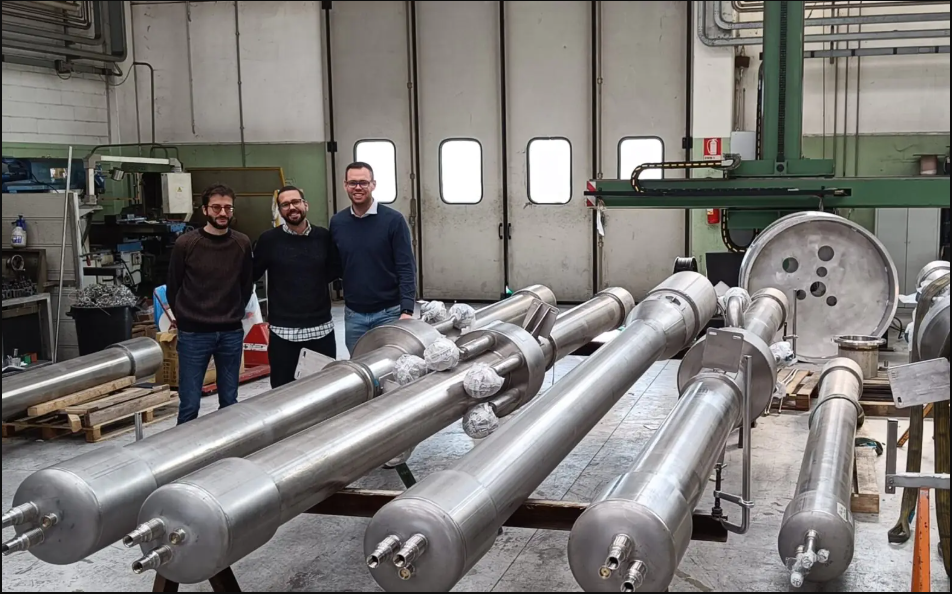
Fusion for Energy completes full delivery of ITER cryopump distribution system
The International Thermonuclear Experimental Reactor (ITER) will operate in an ultra-high vacuum environment. To prevent contamination inside the device, a set of cryopumps supplied by Europe will extract gas particles and alternate operation before and after plasma discharges, maintaining the vacuum vessel pressure at approximately one millionth of Earth's atmospheric pressure. The core of cryopump operation lies in the extremely low-temperature environment. Its internal panels will be cooled to 4 K, approximately minus 269 degrees Celsius, close to absolute zero, to capture gas particles; they are then warmed to release and expel the particles. To precisely control this process, Europe is also supplying ITER with the Front-End Cryopump Distribution System (FECDS), which delivers helium at specific doses and temperatures to the cryopumps...
2026-08-12
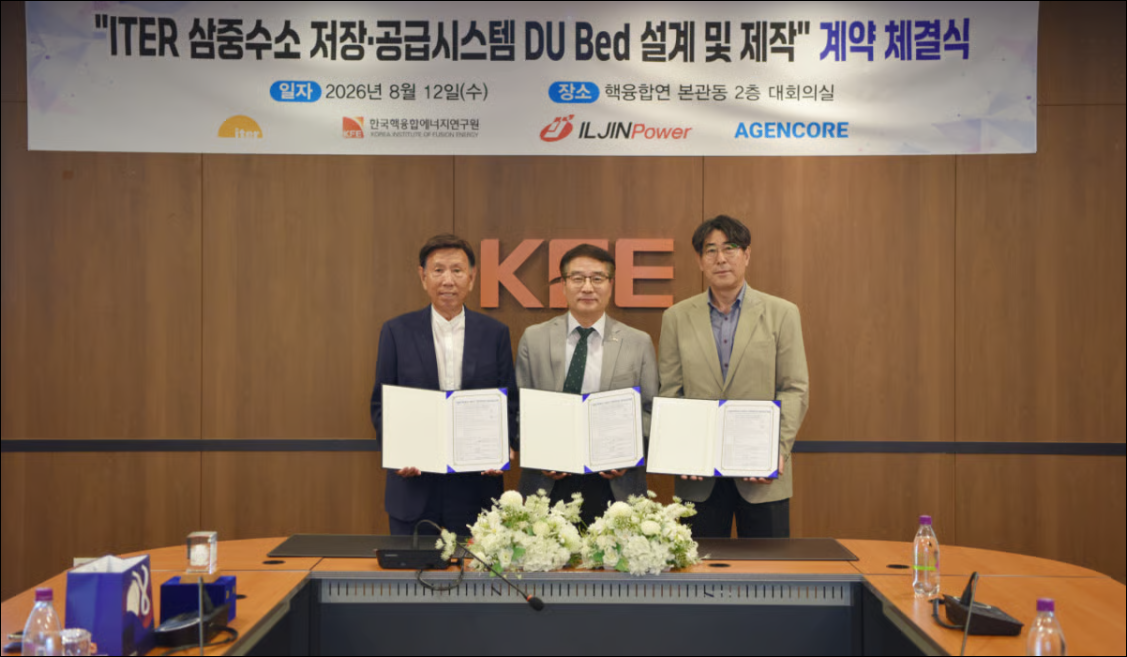
Korea Fusion Energy Institute Launches Design and Manufacturing of ITER Tritium Storage and Supply Vessels
The Korea Fusion Energy Institute (KFE) announced on August 12 at its headquarters in Daejeon that it has signed a contract with a consortium comprising Iljin Power and Aizen Core to undertake the design and manufacturing of the tritium storage and supply vessels for the International Thermonuclear Experimental Reactor (ITER). ITER is currently the world's largest fusion experimental device, being jointly constructed by seven parties—Korea, the United States, the European Union, Japan, China, Russia, and India—in Cadarache, southern France. Under the procurement agreement signed between KFE and the ITER Organization in March 2025, Korea...
2026-08-12
Kyoto Fusioneering and Oak Ridge to Build World's First Fusion Blanket Verification Facility UNITY-3
Kyoto Fusioneering (KF), a Japanese fusion energy engineering company, announced that it will jointly build a facility named UNITY-3 with the U.S. Oak Ridge National Laboratory (ORNL) to verify the breeding blanket technology required for commercial fusion power plants. The project is described as the world's first facility dedicated to breeding blanket demonstration, and KF will also relocate its U.S. business base to Oak Ridge, Tennessee. The project has received support from the U.S. Department of Energy's relevant roadmap, Tennessee's nuclear energy supply chain investment fund, and the DOE, indicating that the fusion industry is shifting from purely plasma physics breakthroughs toward engineering, system integration, and supply chain development. The breeding blanket is a critical component for deuterium-tritium fusion power...
2026-08-12
South Korea Designates Small Modular Reactors and Nuclear Fusion as Key Future Growth Technologies
South Korean President Lee Jae-myung will chair a briefing session on the "Seven Seeds for Future Growth Engines" at the presidential office Cheong Wa Dae on the afternoon of August 12, focusing on the development pathways for advanced technologies including Small Modular Reactors (SMRs) and nuclear fusion, as well as related industrial ecosystems and supply chain security measures. According to Cheong Wa Dae, the meeting aims to jointly study advanced technology deployment with the science and industry communities, support artificial intelligence (AI) transformation, and strengthen South Korea's future industrial foundation capabilities. The seven areas designated as priorities include Small Modular Reactors, nuclear fusion, renewable energy, quantum technology, aerospace, advanced biotechnology, and advanced materials and component supply chains....
2026-08-12

UK's Materials Detritiation Facility at Culham Resumes Operations to Support JET Fusion Decommissioning Materials Research
The UK Atomic Energy Authority recently announced that the Materials Detritiation Facility (MDF) at Culham has resumed operations following a 12-month engineering shutdown and upgrade. Experimental data produced by the facility has already been used to support research related to the removal of materials from the Joint European Torus (JET) device, providing a basis for waste management strategies under the JET Decommissioning and Repurposing (JDR) project. Over three years of plasma operations, deuterium-tritium (DT) experiments conducted at JET have left residual amounts of tritium in the tokamak's walls and internal components. This phenomenon is associated with tritium's tendency to enter materials under high-power fusion operating conditions. For JET decommissioning work, accurately determining the tritium...
2026-08-11
Reading Ranking
- 1 Russia's Kurchatov Institute to Receive 5.7 Billion Rubles in Fiscal Budget Support: Focusing on Controlled Thermonuclear Fusion and Advanced Plasma Technology R&D
- 2 France's ITER research program may start before 2034
- 3 Israel's nT-TaO Signs Memorandum of Understanding with US-based Orion to Explore Deployment of Compact Fusion Systems for Data Center Power Supply
- 4 ITER Tritium Plant Completes Final Design, Fully Transitions to Equipment Manufacturing, Installation, and Commissioning
- 5 Expansion Project Advances at Centrus Energy's Uranium Enrichment Facility in Piketon, Ohio
- 6 Naju City, Korea Proposes Construction of National Fusion Energy Center
- 7 California Signs Two Bills to Reshape Advanced Nuclear Fission and Fusion Energy Strategy
- 8 India's Private Fusion Tokamak PRAGYA Achieves Plasma Operation
- 9 Russia Plans to Build New Tokamak Device Using Reactor Technologies
- 10 Japan's GX Promotion Organization Invests in Nuclear Fusion Startups
- 11 Germany's BEST and Luvata Partner to Expand Supply of RRP Superconductors for Fusion
- 12 US and UK Join Forces to Accelerate Commercialization of Fusion Energy
- 13 US Fusion Company Commonwealth Fusion Systems Secures $1 Billion Investment from South Korea's Hyundai
- 14 U.S. Fusion Energy Company CFS Completes $1 Billion Equity Financing
- 15 Masayoshi Son: Nuclear Fusion Could Become Key to Powering Future AI Data Centers