
Search Results
Keyword:Unit 3

Inner Dome Concrete Pouring of Zhangzhou Nuclear Power Unit 3 Completed
On September 30, as the last batch of concrete was successfully poured into the formwork, China Nuclear Industry 24 Construction Co., Ltd. successfully completed the concrete pouring of the inner dome of the reactor building of the Hualong One Zhangzhou Nuclear Power Unit 3. The achievement of this key milestone marks the full completion of the civil construction of the inner containment for this unit, laying a solid foundation for the subsequent prestressing construction of the containment and the installation of core nuclear equipment. As an important safety barrier of the Hualong One independent third-generation nuclear power technology, the inner dome is located at the top of the nuclear island, and its core function is to ensure the integrity and absolute leak-tightness of the reactor building and prevent the leakage of radioactive substances. Faced with nuclear construction technical challenges such as the complex curved surface structure of the dome and the high difficulty of high-altitude operations, the Zhangzhou Nuclear Power Project Department...
2026-10-02

The pressurizer of Unit 3 of the Zhangzhou Nuclear Power Plant has been hoisted into place.
At 19:03 on September 20, the pressurizer of Unit 3 of the Zhangzhou Nuclear Power Plant was hoisted into place. During this pressurizer hoisting operation, the pressurizer was horizontally lifted to the +16.5m platform by a gantry crane, transported and towed by a heavy-duty vehicle into the reactor building, then turned and erected by the polar crane, and finally hoisted into place. The pressurizer is one of the core main equipment items of the nuclear island reactor coolant system, and its main function is to undertake primary loop pressure control and overpressure protection, among other duties. When the temperature and pressure inside the reactor fluctuate, the pressurizer can maintain the temperature and pressure inside the reactor within a safe range by adjusting the flow rate and temperature of the coolant water, thereby ensuring the safe and stable operation of the reactor. At the same time, the pressurizer is crucial for ensuring the power generation efficiency of the unit and maintaining stable operation, and is key equipment for the safe operation of nuclear power units.
2026-09-21
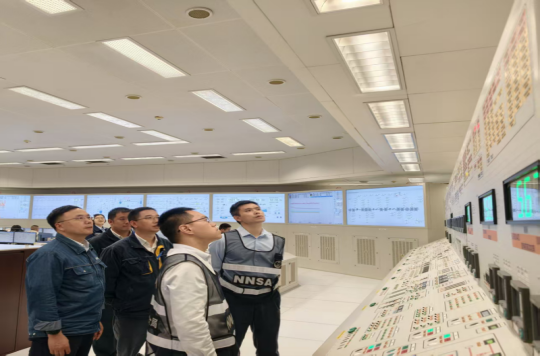
South China Supervision Station Escorts the Safe and Smooth Transition of Changjiang Nuclear Power Plant Unit 3 to Commercial Operation
Recently, the Changjiang Nuclear Power Plant Unit 3, the first Hualong One nuclear power project constructed by Huaneng Group in the Hainan Free Trade Port, successfully completed a 168-hour full-power trial operation. The achievement of this important milestone marks that the unit has officially met the conditions for commercial operation, and also means that as an important supplement to the clean energy structure of the Hainan Free Trade Port, the project is steadily advancing toward the goal of full commissioning, injecting new vitality into local economic and social development. Looking back at the commissioning process of Unit 3, on April 30 of this year, the unit officially completed its first fuel loading and immediately entered the most critical nuclear commissioning phase. During the commissioning period that lasted for months, every...
2026-09-21

Pressurizer of Zhangzhou Nuclear Power Unit 3 Hoisted into Place
At 19:03 on September 20, the pressurizer of Zhangzhou Nuclear Power Unit 3 was hoisted into place. During this pressurizer hoisting operation, the pressurizer was horizontally lifted to the +16.5m platform by a gantry crane, transported by a heavy-duty vehicle into the reactor building, then turned and erected by the polar crane, and finally hoisted into place. The pressurizer is one of the core main equipment items of the nuclear island reactor coolant system, and its main functions include primary loop pressure control and overpressure protection. When the temperature and pressure inside the reactor fluctuate, the pressurizer can maintain the temperature and pressure within the reactor in a safe range by adjusting the flow rate and temperature of the coolant water, ensuring the safe and stable operation of the reactor. At the same time, the pressurizer is...
2026-09-21

Hainan Free Trade Port's first "Hualong One", Huaneng Changjiang Nuclear Power Phase II Unit 3 is about to be officially put into operation
The first Hualong One nuclear power unit in the Hainan Free Trade Port, Huaneng Changjiang Nuclear Power Phase II Unit 3, is about to officially enter commercial operation. Huaneng Changjiang Nuclear Power Phase II is equipped with China's independently developed third-generation Hualong One nuclear power technology and adopts the country's first fully independently controllable group-level nuclear power production management system. It can deliver more than 9 billion kWh of clean electricity to the Hainan power grid each year. The Huaneng Changjiang Nuclear Power Phase II project plans to build Unit 3 and Unit 4, two units with a single-unit capacity of 1.2 million kilowatts. After the two units are fully completed, the annual power generation can reach 18 billion kWh, enough to meet the electricity demand of one-third of Hainan Province's population. Huaneng Changjiang Nuclear Power Phase II Unit 3 is about to be officially put...
2026-09-17

South Korea to Reconsider Accident Management Plans for Four Units at Gori and Hanbit
On September 11, 2026, the Nuclear Safety and Security Commission of South Korea held its 14th meeting of 2026 to review the accident management plans and operating change license applications submitted by Korea Hydro & Nuclear Power (KHNP) for Gori Nuclear Power Plant Units 3 and 4 and Hanbit Nuclear Power Plant Units 1 and 2. The meeting failed to reach a final conclusion and decided to refer the relevant agenda items to the next meeting for continued deliberation. The accident management plan mainly includes the scope of nuclear power plant accident management, management facilities, management strategies, and training programs. For nuclear power units with long operating lives, approval of this plan is generally regarded as an important prerequisite for subsequent discussions on continued operation licenses....
2026-09-12

Unit 3 of Finland's Olkiluoto Nuclear Power Plant automatically disconnected from the grid due to a technical fault
On September 10, several hours before the start of a planned shutdown for maintenance, Unit 3 of Finland's Olkiluoto Nuclear Power Plant automatically disconnected from the grid due to a technical fault detected in the steam generator. The plant operator, Teollisuuden Voima Oyj (TVO), said that at the time of the incident, Unit 3 was gradually reducing power as planned and was already operating at extremely low power. The automatic disconnection occurred earlier than the originally scheduled grid disconnection for maintenance. TVO stated that all plant systems were operating normally and that the event had no impact on nuclear safety. The Olkiluoto Nuclear Power Plant is located on the Olkiluoto Peninsula along the coast of the Gulf of Bothnia in the Baltic Sea in Finland. The plant has three operating units, of which Unit 3...
2026-09-11

Safety review items for Shimane Nuclear Power Plant Unit 3 confirmed, operation planned for 2030
The Nuclear Regulation Authority (NRA) of Japan conducted a safety review of Shimane Nuclear Power Plant Unit 3 on September 10. This review is a necessary procedure before the unit can be put into operation. Chugoku Electric Power Company of Japan has been constructing Shimane Nuclear Power Plant Unit 3 since 2005 and has been undergoing NRA review since 2018. At the review meeting that day, Chugoku Electric Power Company gave explanations regarding earthquake, tsunami, and severe accident response measures for Unit 3. According to the meeting, all review items were confirmed on September 10. Next, Chugoku Electric Power Company will submit a revised document incorporating the relevant content discussed at previous review meetings. The NRA is expected to prepare a draft review report based on this...
2026-09-11

Chubu Electric Power considers withdrawing Hamaoka nuclear plant restart review application
Chubu Electric Power Company (CEPCO) is considering withdrawing its restart review application for Units 3 and 4 of the Hamaoka Nuclear Power Plant. The plant is located in Omaezaki City, Shizuoka Prefecture, Japan, and it was previously revealed that seismic design data related to the restart review was suspected of falsifying "design basis ground motion" data, making the ground motion amplitude in the submitted materials lower than originally expected. On the morning of the 11th, Chubu Electric Power announced that it had received a report submitted by an investigation committee composed of external lawyers. The committee was commissioned by Chubu Electric Power to investigate the causes and process of the seismic design data issue at the Hamaoka Nuclear Power Plant. Chubu Electric Power President Shingo Hayashi and others plan to hold a press...
2026-09-11

First concrete poured for turbine building foundation of Unit 3 VVER-1200 at Leningrad NPP Phase II
On September 9, 2026, concrete pouring began for the foundation of the turbine building of Unit 3 VVER-1200 at Leningrad NPP Phase II in Russia. Construction workers have completed the pouring of the central section of the future foundation, with concrete consumption approaching 5,000 cubic meters. This pour is the first stage of construction of the foundation structure for this building. According to the plan, the contractor will use nearly 5,000 tonnes of rebar and more than 20,000 cubic meters of high-strength concrete to build a monolithic foundation slab 2.5 meters high and more than 8,000 square meters in area. The related operations are currently being carried out simultaneously in 7 construction zones. Konstantin Khudyakov, head of the Leningrad NPP project at TITAN-2 Holding (TITAN-2), said that the foundation construction of the turbine building places high demands on concrete quality, pouring technology and curing conditions, especially in the first few days after pouring, when it is necessary to focus on controlling on-site temperature and humidity and preventing mechanical damage. After the concrete reaches design strength, the contractor will, together with the owner, use non-destructive testing methods to inspect the structure, including ultrasonic testing; at the same time, specimens made from the same batch of concrete will also be subjected to compressive tests on a hydraulic press to confirm that the foundation is capable of bearing the loads of walls, floors, piping and large operating equipment.
2026-09-10

Long-term operation upgrades advanced during outage of Czech Dukovany Unit 3
On September 8, 2026, CEZ Group (CEZ) is utilizing the current outage maintenance window of Unit 3 at the Dukovany Nuclear Power Plant to carry out large-scale modernization of the turbine hall and secondary circuit. These systems are responsible for converting the thermal energy generated by the reactor into electricity and delivering it to the transmission grid. CEZ stated that during this outage, technicians will perform hundreds of inspections, repairs, maintenance activities, and modifications on secondary circuit equipment. In addition to routine inspections required by regulations and operating procedures, preventive maintenance, defect resolution, and equipment upgrades will also be carried out on site, creating conditions for the plant's goal of operating for up to 80 years. Roman Havlín, Director of the Dukovany Nuclear Power Plant, stated that while outage maintenance at nuclear power plants typically draws more attention to the reactor and primary circuit, the turbine hall equipment that ensures actual electricity generation is equally critical, and related equipment will also receive intensive maintenance during the outage.
2026-09-09

Restart of Unit 3 at Japan's Tomari Nuclear Power Plant May Be Delayed to After End of 2027
The restart of Unit 3 at the Tomari Nuclear Power Plant, operated by Hokkaido Electric Power in Tomari Village, Hokkaido, Japan, may be delayed to after the end of 2027. The company currently maintains its stated target of a restart in early 2027, but has not yet provided a specific date. Key factors affecting the restart schedule include delays in the construction of the tsunami protection embankment, a fatal accident during construction that occurred during the review process by the Nuclear Regulation Authority (NRA) of Japan, and certain technical matters that remain under confirmation and consultation. Hokkaido Electric Power has stated that the embankment is expected to be completed by mid-August 2027. The project was originally scheduled for completion around March 2027, but has been extended due to blizzard conditions and additional...
2026-09-08

Unit 3 at Saeul Nuclear Power Plant in South Korea Shut Down Again During Trial Operation
Unit 3 at the Saeul Nuclear Power Plant, operated by Korea Hydro & Nuclear Power (KHNP), was shut down again during trial operation. The unit, located in Ulju County, Ulsan, South Korea, has a generating capacity of 1,400 MW. According to the plant operator, operators manually shut down the reactor at approximately 3:01 p.m. on the 6th. The shutdown was initiated after a leak was confirmed in a pipe related to turbine steam condensate. The plant stated that the manual shutdown was carried out to ensure facility stability and facilitate maintenance. The plant also stated that the shutdown caused no radiological impact and that the unit is currently in a stable condition. Personnel are analyzing the cause of the pipe leak. This...
2026-09-07

Japan's Tomari Nuclear Power Plant Unit 3 Restart Review Still Requires Additional Fire Safety Documentation
On September 3, a review meeting was held for the restart plan of Unit 3 at Japan's Tomari Nuclear Power Plant. The Nuclear Regulation Authority (NRA) pointed out that the explanations submitted by Hokkaido Electric Power regarding fire safety measures still contain issues requiring further confirmation, and requested the company to provide more detailed assessment materials. The equipment design and construction plan required for the restart of Tomari Unit 3 has been under review since last year. One of the current review priorities is whether relevant workers have adequate and feasible evacuation measures in the event of a fire on site. At the meeting that day, representatives of Hokkaido Electric Power explained the revised fire safety...
2026-09-04

Cause Identified for Automatic Shutdown of Unit 3 at Shin-Kori Nuclear Power Plant in South Korea
The Nuclear Safety and Security Commission (NSSC) of South Korea reported on the 4th that it has completed its investigation into the automatic shutdown of Unit 3 at the Shin-Kori nuclear power plant during commissioning tests on the 11th of last month, and has approved the resumption of commissioning tests for the unit. The investigation confirmed that the direct cause of the incident was an operator error in inputting parameters during the process of restoring reactor power after the tests. According to the investigation findings, at the time of the incident, while setting the parameters for the turbine control valve position limiter, the operator mistakenly entered a value intended to limit the upper opening limit of the valve as a value in the valve closing direction. This limiter is used to prevent a rapid increase in the amount of steam entering the turbine for power generation within a short period. After the parameter error, the unit experienced an interruption in power output at approximately 80% power level, followed by an automatic shutdown.
2026-09-04