
Search Results
Keyword:3

Italy may restart nuclear power generation by 2035
Italian Minister of Environment and Energy Security Gilberto Pichetto Fratin stated that the Italian government does not rule out the possibility of restarting domestic nuclear power generation by 2035. If mass production of nuclear reactors begins by the end of this decade, their construction time could be shortened to three to four years. This might allow Italy to begin generating electricity in 2034 or 2035. The bill aims to establish the legal framework needed for Italy to build new nuclear reactors. Since the referendum held after the 1987 Chernobyl nuclear accident and the closure of the last nuclear power plants in 1990, Italy has consistently prohibited nuclear energy. However, geopolitical uncertain...
2026-09-20

Hainan Free Trade Port's first "Hualong One", Huaneng Changjiang Nuclear Power Phase II Unit 3 is about to be officially put into operation
The first Hualong One nuclear power unit in the Hainan Free Trade Port, Huaneng Changjiang Nuclear Power Phase II Unit 3, is about to officially enter commercial operation. Huaneng Changjiang Nuclear Power Phase II is equipped with China's independently developed third-generation Hualong One nuclear power technology and adopts the country's first fully independently controllable group-level nuclear power production management system. It can deliver more than 9 billion kWh of clean electricity to the Hainan power grid each year. The Huaneng Changjiang Nuclear Power Phase II project plans to build Unit 3 and Unit 4, two units with a single-unit capacity of 1.2 million kilowatts. After the two units are fully completed, the annual power generation can reach 18 billion kWh, enough to meet the electricity demand of one-third of Hainan Province's population. Huaneng Changjiang Nuclear Power Phase II Unit 3 is about to be officially put...
2026-09-17

Blue Energy Submits Construction Permit Application to U.S. Nuclear Regulatory Commission to Advance Texas Gas-to-Nuclear Project
Blue Energy announced that it has submitted Part One of its construction permit application to the U.S. Nuclear Regulatory Commission (NRC) for its first gas-to-nuclear project at Port Victoria, Texas. This milestone move makes Blue Energy one of only five nuclear energy companies to have submitted a construction permit application to the NRC in the current new wave of nuclear power development. Blue Energy employs the Blue Way of prefabricated and standardized construction, transport, and assembly of nuclear power plants. Compared with traditional nuclear power projects, this model can shorten project commissioning time by more than a decade and significantly reduce costs and construction risks. With the final investment decision expected to be made in 2027, the project plans to deploy GE Vernova 7HA.02 gas turbines and GE Vernova Hitachi BWRX-300 small modular reactors (SMRs) to create a first-of-its-kind gas-to-nuclear hybrid power plant.
2026-09-17

Syria Places 73 Tonnes of Uranium Under IAEA Safeguards
Syrian Foreign Minister Asaad al-Shaibani recently announced that Damascus has placed 73 tonnes of natural uranium under International Atomic Energy Agency (IAEA) supervision, marking the closure of Syria's 15-year nuclear non-compliance file and the beginning of renewed cooperation with the watchdog. According to the Syrian state news agency SANA, al-Shaibani told the IAEA General Conference via video that the Board of Governors unanimously decided on September 9 to close Syria's nuclear file. The file had remained open since 2011. He noted that Damascus sent an official letter to the IAEA on July 17 disclosing that it possessed nuclear material at an undeclared location, and subsequently on July...
2026-09-16

Rosatom Completes First Stage of Concrete Pouring for BREST Reactor Core Cavity
TVEL Fuel Company, a subsidiary of Rosatom, has announced that the future innovative nuclear power unit BREST-OD-300, located in Seversk, Tomsk Oblast, has successfully completed the first stage of concrete pouring for the reactor core inner cavity. The reactor is located at the site of the Generation IV Pilot Demonstration Energy Complex (ODEK) within the Siberian Chemical Combine (SCC) area, and is a core component of Russia's national strategic industry project Proryv (Breakthrough). The report noted that concrete pouring for the reactor body will proceed in multiple stages, with full completion expected in the winter of 2027, by which time the total amount of heat-resistant concrete used will exceed 7,000 cubic meters...
2026-09-14

Lower likelihood of restart for Belgium's Doel 3 and Tihange 2 reactors
According to a September 11 report by Le Soir, samples collected nearly two years ago from the reactor pressure vessels of Belgium's Doel 3 and Tihange 2 reactors indicate that the possibility of restarting these two nuclear reactors is extremely low. In the winter of 2024 to 2025, operator Engie successively took samples from the Doel 3 reactor pressure vessel and the Tihange 2 reactor pressure vessel. The sampling work was carried out at the request of the Belgian Federal Agency for Nuclear Control (FANC) and the Belgian National Agency for Radioactive Waste and Enriched Fissile Materials (NIRAS), which is responsible for radioactive waste management, with the aim of measuring in detail the radiation levels at different parts of the pressure vessels so as to classify and dispose of the related waste.
2026-09-13
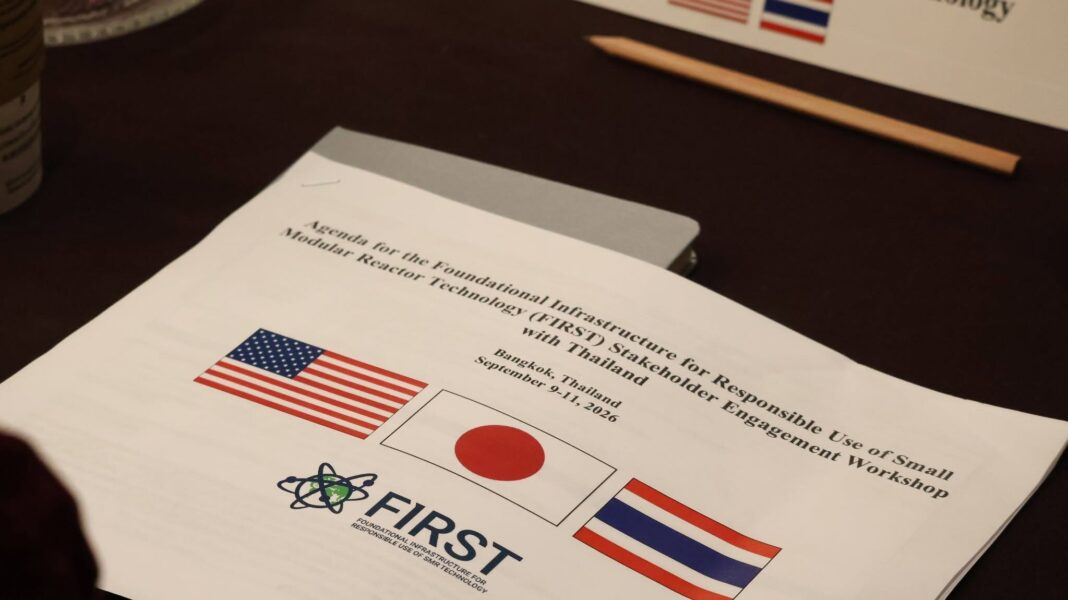
Thailand Advances SMR Regulatory and Public Engagement Preparations, Plans to Commission First Unit by 2037
From September 9 to 11, 2026, the U.S. Department of State held the FIRST and Thailand Stakeholder Engagement Workshop in Bangkok. The workshop was co-hosted by the Thailand Institute of Nuclear Technology (TINT) and the Electricity Generating Authority of Thailand (EGAT), aiming to support Thailand's preliminary preparations for small modular reactors (SMRs), with a focus on transparent communication, public trust, and stakeholder engagement. The FIRST program, whose full name is Foundational Infrastructure for the Responsible Use of Small Modular Reactor Technology, was initiated by the U.S. Department of State and mainly supports relevant countries in...
2026-09-12

South Gyeongsang Province, South Korea Releases SMR Development Strategy 2.0, Sets 2035 Manufacturing Market Share Target
On September 10, 2026, South Gyeongsang Province, South Korea announced the Small Modular Reactor Global Development Strategy 2.0, proposing to build the region into the world's leading small modular reactor (SMR) production hub by 2035, and striving to capture 60% of the global SMR manufacturing market and achieve 100% self-sufficiency in related technologies. South Gyeongsang Province stated that multiple tasks included in the Small Modular Reactor Global Development Strategy 1.0 formulated last year, including promoting the enactment of a special SMR law, designating SMR as a national strategic technology, designating an SMR specialized complex, establishing a full-cycle SMR support system, and relaxing relevant regulatory requirements, have already been reflected in the South Korean government's policies. Therefore...
2026-09-13

South Korea's SMR Special Act Takes Effect, Aiming to Commercialize Light Water SMRs by 2035
On September 11, 2026, the South Korean Ministry of Science and ICT (MSIT) announced that the Special Act on the Promotion of and Support for the Development of Small Modular Reactors, along with its enforcement decree, which aims to promote the research and development, demonstration, and commercialization of small modular reactors (SMRs), took effect on that day. Against the backdrop of growing electricity demand driven by the rapid spread of artificial intelligence and data centers, the South Korean government plans to increase support for the SMR sector through measures such as seven SEED projects. Under the Special Act and its enforcement decree, MSIT will formulate a basic plan for small modular reactor system development every five years, and prepare annual implementation...
2026-09-12

South Korea to Reconsider Accident Management Plans for Four Units at Gori and Hanbit
On September 11, 2026, the Nuclear Safety and Security Commission of South Korea held its 14th meeting of 2026 to review the accident management plans and operating change license applications submitted by Korea Hydro & Nuclear Power (KHNP) for Gori Nuclear Power Plant Units 3 and 4 and Hanbit Nuclear Power Plant Units 1 and 2. The meeting failed to reach a final conclusion and decided to refer the relevant agenda items to the next meeting for continued deliberation. The accident management plan mainly includes the scope of nuclear power plant accident management, management facilities, management strategies, and training programs. For nuclear power units with long operating lives, approval of this plan is generally regarded as an important prerequisite for subsequent discussions on continued operation licenses....
2026-09-12

First Supercapacitor Pulsed Power Supply System of the HL-3 Upgrade Project Successfully Handed Over
On September 10, the 300MVA/3000MJ supercapacitor pulsed power supply system of the HL-3 upgrade project was successfully handed over. This is the first system of the project to complete handover, marking that the project construction is gradually transitioning from the equipment installation and subsystem static commissioning stage to the system joint commissioning stage, providing support for advancing fusion engineering. Zhang Libo, President and Deputy Secretary of the Party Committee of the Southwestern Institute of Physics, and Chen Qingchuan, Vice President, attended the handover ceremony. Zhang Libo stated at the ceremony that the completion of the handover of the first system is the result of collaborative efforts by all participating units, accumulating experience and creating conditions for subsequent system joint commissioning. All parties will continue to consolidate responsibilities and advance key milestones on schedule....
2026-09-12

Unit 3 of Finland's Olkiluoto Nuclear Power Plant automatically disconnected from the grid due to a technical fault
On September 10, several hours before the start of a planned shutdown for maintenance, Unit 3 of Finland's Olkiluoto Nuclear Power Plant automatically disconnected from the grid due to a technical fault detected in the steam generator. The plant operator, Teollisuuden Voima Oyj (TVO), said that at the time of the incident, Unit 3 was gradually reducing power as planned and was already operating at extremely low power. The automatic disconnection occurred earlier than the originally scheduled grid disconnection for maintenance. TVO stated that all plant systems were operating normally and that the event had no impact on nuclear safety. The Olkiluoto Nuclear Power Plant is located on the Olkiluoto Peninsula along the coast of the Gulf of Bothnia in the Baltic Sea in Finland. The plant has three operating units, of which Unit 3...
2026-09-11

Safety review items for Shimane Nuclear Power Plant Unit 3 confirmed, operation planned for 2030
The Nuclear Regulation Authority (NRA) of Japan conducted a safety review of Shimane Nuclear Power Plant Unit 3 on September 10. This review is a necessary procedure before the unit can be put into operation. Chugoku Electric Power Company of Japan has been constructing Shimane Nuclear Power Plant Unit 3 since 2005 and has been undergoing NRA review since 2018. At the review meeting that day, Chugoku Electric Power Company gave explanations regarding earthquake, tsunami, and severe accident response measures for Unit 3. According to the meeting, all review items were confirmed on September 10. Next, Chugoku Electric Power Company will submit a revised document incorporating the relevant content discussed at previous review meetings. The NRA is expected to prepare a draft review report based on this...
2026-09-11

Chubu Electric Power considers withdrawing Hamaoka nuclear plant restart review application
Chubu Electric Power Company (CEPCO) is considering withdrawing its restart review application for Units 3 and 4 of the Hamaoka Nuclear Power Plant. The plant is located in Omaezaki City, Shizuoka Prefecture, Japan, and it was previously revealed that seismic design data related to the restart review was suspected of falsifying "design basis ground motion" data, making the ground motion amplitude in the submitted materials lower than originally expected. On the morning of the 11th, Chubu Electric Power announced that it had received a report submitted by an investigation committee composed of external lawyers. The committee was commissioned by Chubu Electric Power to investigate the causes and process of the seismic design data issue at the Hamaoka Nuclear Power Plant. Chubu Electric Power President Shingo Hayashi and others plan to hold a press...
2026-09-11

CGN's 33 in-operation nuclear power units achieve RMB-denominated pricing and settlement for operational period insurance
On September 10, the "CGN In-Service Nuclear Power Plant Operational Period Insurance Project Co-Insurance Agreement" was signed in Shenzhen. The agreement achieves RMB-denominated pricing and settlement for major types of nuclear power plant operational period insurance, changing the convention of China's nuclear insurance market's over thirty years of primarily relying on foreign currency transactions. Nuclear insurance is an important type of insurance for ensuring the safe and stable operation of nuclear power units. Due to the enormous insured amount of a single policy, it typically requires joint underwriting by hundreds of insurance companies both domestically and internationally, and is regarded by the insurance industry as one of the most special and complex types of insurance. Since China's first nuclear power plant operational insurance policy——the Daya Bay Nuclear Power Plant operational insurance policy——was issued in 1993, China's nuclear power industry has long followed mature foreign models...
2026-09-11